



How to Choose a 60V Electric Motorcycle Battery Supplier?
The battery pack is an important component of an electric motorcycle. It provides power for the motor system and directly affects the vehicle’s riding range, charging requirements, and operating performance.
For electric motorcycle manufacturers, distributors, and vehicle developers, choosing a suitable 60V battery supplier requires consideration of several factors, including battery design, cell selection, Battery Management System (BMS), production process, and compliance requirements.
A 60V lithium battery pack is commonly used in electric motorcycles, scooters, delivery vehicles, and other light electric mobility applications. Compared with lower-voltage systems, 60V battery solutions can support applications that require higher power output while maintaining a practical battery size.
When selecting a battery supplier, companies should evaluate not only the battery specifications but also the supplier’s engineering capability and manufacturing process.
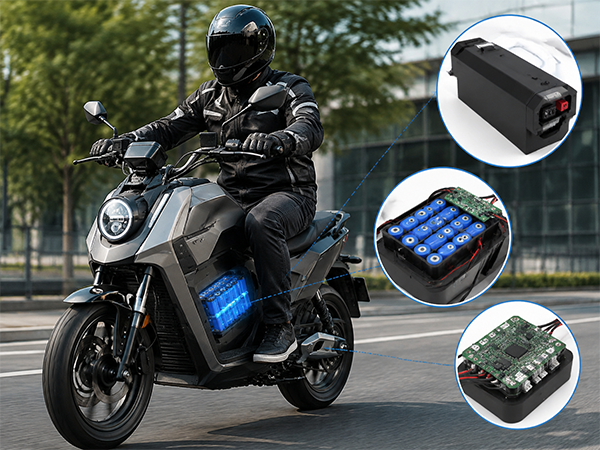
What Is a 60V Electric Motorcycle Battery?
A 60V electric motorcycle battery is a rechargeable lithium battery pack designed for electric vehicles using a 60V electrical system.
A complete battery solution usually includes:
Battery cells
Battery Management System (BMS)
Protection circuit
Wiring harness
Connectors
Battery enclosure
Charging interface
The final battery configuration depends on the vehicle design and application requirements.
Common 60V battery specifications include:
| Battery Specification | Typical Application |
|---|---|
| 60V 15Ah-20Ah | Urban commuting electric motorcycles |
| 60V 25Ah-30Ah | Daily transportation vehicles |
| 60V 40Ah+ | Delivery and commercial applications |
Battery capacity selection depends on:
Motor power
Controller current
Expected riding distance
Vehicle weight
Installation space
Factors to Consider When Choosing a 60V Electric Motorcycle Battery Supplier
1. Battery Design and Engineering Capability
A suitable battery supplier should be able to design battery packs according to vehicle requirements.
Electric motorcycle battery design involves:
Battery size confirmation
Cell configuration
Electrical parameters
BMS selection
Structural design
Connector matching
Different vehicles may require different battery solutions.
For example:
A commuter electric motorcycle may focus on:
Compact size
Suitable capacity
Daily charging cycles
A delivery vehicle may require:
Higher cycle frequency
Stable discharge performance
Durable battery structure
A supplier with battery engineering experience can help customers develop a battery pack that matches the vehicle system.
2. Battery Cell Selection
Battery cells are the basic energy storage unit inside a battery pack.
When evaluating a battery supplier, customers should understand:
Cell brand
Cell chemistry
Capacity specification
Discharge performance
Quality control process
Common lithium battery cell types include:
NMC Lithium Battery Cells
NMC (Nickel Manganese Cobalt) batteries are commonly used in applications where energy density is an important consideration.
Features:
Higher energy density compared with some lithium chemistries
Suitable for compact battery designs
Commonly used in electric mobility products
Applications:
Electric motorcycles
Electric scooters
Long-range mobility vehicles
LiFePO4 Battery Cells
LiFePO4 (Lithium Iron Phosphate) batteries are used in applications requiring stable operation and long cycle performance.
Features:
Stable chemical characteristics
Suitable for frequent charging and discharging
Good temperature performance
Applications:
Delivery vehicles
Commercial electric motorcycles
Fleet applications
3. Battery Management System (BMS)
The Battery Management System is an important part of a lithium battery pack.
For a 60V electric motorcycle battery, the BMS manages battery operating conditions and provides protection functions.
Common BMS functions include:
Overcharge protection
Over-discharge protection
Over-current protection
Short-circuit protection
Temperature monitoring
Cell balancing
Some applications may require smart BMS functions, such as:
CAN communication
UART communication
RS485 communication
Bluetooth monitoring
Smart BMS solutions can help vehicle manufacturers monitor battery information and support maintenance management.
4. Battery Pack Customization Capability
Electric motorcycle manufacturers often require customized battery solutions because different vehicles have different designs.
A battery supplier should be able to support:
Voltage and Capacity Design
Examples:
48V battery packs
60V battery packs
72V battery packs
Capacity can be adjusted according to:
Vehicle range requirements
Available installation space
Operating conditions
Structural Customization
Battery structure design may include:
Battery housing
Mounting method
Waterproof protection
Cable arrangement
Connector selection
For outdoor electric motorcycles, battery protection against vibration, dust, and moisture should be considered during design.
5. Manufacturing Process and Quality Control
Before selecting a supplier, buyers should understand the manufacturer’s production process.
A typical lithium battery PACK production process includes:
Cell Inspection
Before assembly, battery cells are checked for:
Voltage consistency
Internal resistance
Capacity performance
Cell matching helps improve battery pack consistency.
PACK Assembly
The assembly process may include:
Cell arrangement
Spot welding
Laser welding
BMS installation
Wiring connection
Housing assembly
Battery Testing
Battery manufacturers usually perform different tests before shipment:
Charging test
Discharging test
Protection function test
Communication test
Aging test
Testing procedures help verify that battery packs meet the designed specifications.
6. Certification and Compliance Requirements
For international electric motorcycle markets, battery products may need to meet transportation and regional requirements.
Common documents and standards include:
UN38.3
UN38.3 is related to lithium battery transportation safety testing.
It evaluates battery performance under transportation conditions.
IEC 62133-2
IEC 62133-2 provides safety requirements for rechargeable lithium batteries.
CE and RoHS
These requirements are commonly considered for products entering European markets.
EU Battery Regulation
Companies supplying batteries to Europe should pay attention to battery-related compliance requirements, including documentation and supply chain information.
7. Evaluate Supplier Experience and Service Capability
A suitable battery supplier should provide support throughout the project.
Important capabilities include:
Technical communication
Prototype development
Sample testing
Production planning
Quality documentation
After-sales support
For OEM projects, cooperation usually involves multiple stages:
Battery requirement confirmation
Battery design
Prototype production
Testing and adjustment
Mass production
60V Electric Motorcycle Battery Solutions from Dongguan Yizhan Electronics
Dongguan Yizhan Electronics Technology Co., Ltd. (FirstPower) focuses on lithium battery PACK development and manufacturing.
The company provides customized battery solutions for:
Electric motorcycles
Electric bicycles
Electric scooters
Industrial vehicles
Robotics
Medical equipment
Yizhan Electronics supports:
18650 lithium battery packs
21700 lithium battery packs
LiFePO4 battery packs
Custom BMS solutions
Manufacturing Capability
The production process includes:
Battery cell inspection
Cell sorting
PACK assembly
Welding process
BMS installation
Aging testing
Final quality inspection
Custom Battery Development
Yizhan Electronics works with customers on:
Battery voltage selection
Capacity design
Mechanical structure
Communication requirements
Production requirements
The company provides OEM and ODM battery PACK services based on different electric mobility applications.
Conclusion
Selecting a 60V electric motorcycle battery supplier requires evaluating battery technology, customization capability, manufacturing process, and compliance support.
Key evaluation points include:
Battery cell quality
BMS design
PACK engineering capability
Production control
Testing procedures
Certification support
A suitable battery supplier can help electric motorcycle companies develop battery solutions that match their vehicle design and application requirements.
First Power provides customized lithium battery PACK solutions for electric mobility applications, supporting customers from battery design to production.

 E-mail


 +86 13510702894