



Lithium Battery for Electric Ride-On Suitcases: Battery Design, BMS, Safety and OEM Solutions
Electric ride-on suitcases combine luggage storage with electric mobility. They are designed for travel environments such as airports, terminals, hotels, exhibitions, and large transportation facilities. A typical product integrates a suitcase body, electric motor, lithium battery, BMS, controller, wheels, braking system, and charging system.
For manufacturers, the battery is an important part of the product architecture. Battery voltage, capacity, discharge current, dimensions, weight, BMS, charging system, and safety design all need to match the complete vehicle system.
This guide explains the key considerations for selecting and developing lithium batteries for electric ride-on suitcases.
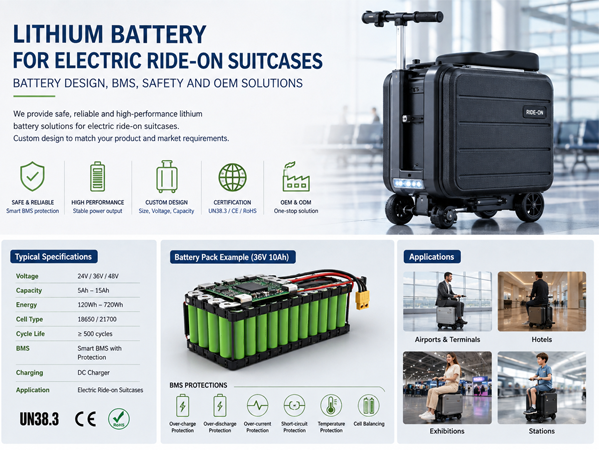
What Is an Electric Ride-On Suitcase?
An electric ride-on suitcase is powered luggage that allows a user to sit on and ride the suitcase in suitable environments.
The electrical system commonly includes:
Lithium battery PACK
Electric motor
Motor controller
BMS
Charger
Throttle or control system
Battery indicator
Wheels and braking system
Battery requirements depend on the motor power, controller, vehicle weight, rider load, operating time, and product structure.
A compact suitcase used for short-distance transportation may require a different battery from a model designed for frequent riding.
Why Use a Lithium Battery?
Lithium-ion batteries are suitable for many portable electric products because they provide rechargeable energy in a compact PACK.
For electric ride-on suitcases, important characteristics include:
Compact dimensions
Low battery weight
Flexible PACK configuration
Suitable discharge capability
BMS protection
Rechargeable operation
Low routine maintenance
Battery design needs to balance electric driving requirements with luggage space. An oversized battery can increase product weight and reduce available storage space.
How to Choose Battery Voltage and Capacity
Battery voltage must match the motor controller and electrical system.
Common voltage classes for small electric mobility products include:
24 V
36 V
48 V
The actual voltage should be determined by the motor and controller specifications.
Battery energy can be calculated using:
Wh = V × Ah
For example:
36 V × 10 Ah = 360 Wh
This means the battery has approximately 360 Wh of nominal energy.
Actual riding time depends on motor power, rider weight, vehicle weight, speed, acceleration, terrain, and operating conditions.
Battery capacity should therefore be selected from the expected energy consumption rather than Ah alone.
Lithium Battery Chemistry
Two lithium-ion chemistries that may be considered for electric mobility products are NMC and LiFePO4.
NMC Battery
NMC batteries can provide high energy density and are suitable for applications where battery size and weight are important.
Potential applications include:
Electric ride-on suitcases
E-bikes
Electric scooters
Portable mobility equipment
LiFePO4 Battery
LiFePO4, or lithium iron phosphate, can be considered for applications requiring stable operation and frequent cycling.
It may be used for:
Mobility equipment
Utility vehicles
Golf carts
Industrial equipment
The appropriate chemistry depends on the product's voltage, capacity, current, weight, space, temperature, and service requirements.
18650 and 21700 Battery Cells
Cylindrical cells are commonly used in compact lithium battery PACKs.
Common formats include:
18650
and
21700
The cell selection should consider:
Capacity
Continuous discharge current
Internal resistance
Dimensions
Temperature characteristics
Supplier consistency
For example, a 10S2P configuration using 3.6 V, 5 Ah cells provides approximately:
36 V nominal voltage + 10 Ah capacity
Nominal energy is approximately:
36 V × 10 Ah = 360 Wh
The final configuration should be based on actual cell specifications and the vehicle load profile.
Continuous and Peak Current
The battery needs to support the motor's electrical demand.
Current requirements can increase during:
Starting
Acceleration
Incline operation
Sudden load changes
A simplified relationship is:
Power = Voltage × Current
For example:
36 V × 15 A = 540 W
The battery manufacturer should evaluate both continuous and peak current.
If the battery or BMS cannot support the required peak current, protection may activate during acceleration.
Cell selection and BMS settings should therefore be matched to the motor controller.
BMS for Electric Ride-On Suitcases
The Battery Management System is a key part of a lithium battery PACK.
A BMS can monitor:
Cell voltage
Battery voltage
Charging current
Discharge current
Temperature
State of charge
Protection status
Typical protection functions include:
Overcharge protection
Over-discharge protection
Overcurrent protection
Short-circuit protection
Over-temperature protection
Under-temperature protection
For smart electric luggage, the BMS can also support communication through interfaces such as:
UART
CAN
RS485
Bluetooth
The communication protocol should be confirmed during the OEM development stage.
Battery Charging
The charger must be compatible with the battery chemistry and PACK configuration.
Important parameters include:
Battery voltage
Full-charge voltage
Charging current
Charging profile
Connector
BMS requirements
Charging time can be roughly estimated as:
Charging Time ≈ Capacity ÷ Charger Current
For example, a 10 Ah battery with a 2 A charger has a theoretical charging time of around five hours.
Actual charging time varies according to the charging profile and final charging stage.
Battery Weight and Dimensions
Electric ride-on suitcases have limited internal space.
The battery may need to fit around:
Motor
Controller
Wheels
Frame
Handle
Luggage compartment
Charging port
A custom battery PACK can be designed according to the available space.
Important mechanical specifications include:
Length
Width
Height
Weight
Mounting points
Connector position
Cable routing
For portable luggage, battery weight should be evaluated together with the motor, frame, wheels, and luggage capacity.
Waterproofing and Vibration Protection
Ride-on suitcases can encounter water splash, dust, vibration, and mechanical shock.
Depending on the application, the battery enclosure may require:
Sealed housing
Gaskets
Waterproof connectors
Cable glands
Internal insulation
Mechanical supports
Battery PACK design should also consider vibration and shock resistance.
Important structural elements include:
Cell fixation
Busbar structure
Welding quality
Connector retention
Cable routing
Housing strength
Testing should reflect the intended operating environment.
Lithium Battery Safety
Battery safety depends on cell quality, PACK design, BMS protection, charging equipment, manufacturing processes, and operating conditions.
A professional battery design should consider:
Cell Quality + BMS + Electrical Protection + Thermal Management + Mechanical Protection + Testing
Manufacturing quality control can include:
Cell inspection
Cell matching
Welding inspection
BMS testing
Insulation testing
Capacity testing
Aging testing
Final inspection
Safety should be considered from the beginning of battery development.
Battery Testing and Certification
Depending on the application and target market, battery testing may include:
Electrical Testing
Capacity
Voltage
Charge/discharge
BMS protection
Environmental Testing
Temperature
Humidity
Water
Dust
Mechanical Testing
Vibration
Shock
Drop
Lithium batteries for international transportation may also require UN 38.3 testing and appropriate shipping documentation.
Other requirements may include IEC standards, CE-related requirements, RoHS, EU Battery Regulation, or country-specific regulations.
Certification requirements should be confirmed according to the final battery design and target market.
Airline and Travel Considerations
Because electric ride-on suitcases are travel products, battery transportation requirements require special attention.
Airline policies can depend on:
Battery energy in Wh
Battery configuration
Whether the battery is removable
Product design
Airline requirements
Manufacturers should not assume that one battery design is accepted by every airline.
The battery's voltage, Ah, and Wh rating should be clearly identified. Transportation documentation should match the actual battery model.
OEM and ODM Lithium Battery Solutions
Custom battery development can be useful when a standard battery does not fit the product.
Customization can include:
Voltage
Capacity
18650 or 21700 cells
Cell configuration
Battery dimensions
Weight
BMS
CAN / UART / RS485
Connector
Battery housing
Charging system
Waterproof design
A typical OEM development process includes:
Requirement Analysis → Cell Selection → PACK Design → BMS Integration → Prototype → Vehicle Testing → Validation → Certification → Mass Production
The battery manufacturer should work with the product manufacturer during the early design stage.
How to Choose an Electric Ride-On Suitcase Battery Manufacturer
B2B buyers should evaluate both technical and production capabilities.
Important questions include:
Can the supplier customize battery dimensions?
Can it develop or integrate the BMS?
Can it provide prototype batteries?
Can it perform capacity and aging tests?
Can it conduct vibration or environmental testing?
Can it support certification requirements?
Can it provide cell traceability?
Can it support mass production?
A suitable supplier should be able to understand the relationship between the battery, motor, controller, charger, and mechanical structure.
Electric Ride-On Suitcase Battery Selection Checklist
Before confirming a battery design, check:
Electrical
☐ Voltage
☐ Capacity
☐ Energy
☐ Continuous current
☐ Peak current
Cells
☐ Chemistry
☐ Cell format
☐ Capacity
☐ Current capability
BMS
☐ Overcharge protection
☐ Over-discharge protection
☐ Overcurrent protection
☐ Temperature protection
☐ Cell balancing
☐ Communication
Mechanical
☐ Dimensions
☐ Weight
☐ Mounting
☐ Connector
☐ Removable or fixed design
Compliance
☐ UN 38.3
☐ Applicable standards
☐ Transportation requirements
☐ Target-market regulations
Frequently Asked Questions
What battery is used in an electric ride-on suitcase?
Electric ride-on suitcases commonly use rechargeable lithium-ion battery PACKs. The exact battery depends on the motor, controller, capacity, dimensions, and product design.
What voltage does an electric ride-on suitcase use?
Common voltage classes include 24 V, 36 V, and 48 V. The correct voltage must match the electrical system.
How do I calculate battery energy?
Use:
Wh = V × Ah
A 36 V 10 Ah battery provides approximately 360 Wh of nominal energy.
Does a ride-on suitcase battery need a BMS?
Yes. A lithium battery PACK should use a suitable BMS for cell monitoring and protection.
Can the battery be customized?
Yes. OEM/ODM manufacturers can customize voltage, capacity, dimensions, connectors, BMS, communication, and housing.
Can the battery be removed?
A removable battery can be developed when supported by the product structure. Mechanical locking and electrical protection should be considered.
Can electric ride-on suitcase batteries be transported by air?
Airline requirements vary according to battery energy, configuration, removability, and airline policy. Manufacturers should verify the current requirements for the target market and airline.
Conclusion
Lithium battery design for electric ride-on suitcases requires coordination between electrical, mechanical, thermal, safety, and transportation requirements.
The battery should be matched with the:
Motor → Controller → BMS → Charger → Mechanical Structure
Key specifications include voltage, capacity, energy, continuous current, peak current, cell chemistry, dimensions, weight, BMS functions, charging requirements, environmental protection, testing, and certification.
For B2B manufacturers, OEM and ODM battery development provides flexibility to create a PACK around the actual suitcase design.
A battery manufacturer can support the process from cell selection and PACK design to BMS integration, prototype production, testing, certification support, and mass production.
For electric ride-on suitcase manufacturers, providing the motor specification, controller information, battery compartment dimensions, desired operating time, charger specification, and target-market requirements is a practical starting point for developing a custom lithium battery solution.
Custom Lithium Battery OEM/ODM
Dongguan Yizhan Electronics Technology Co., Ltd. provides customized lithium battery PACK solutions for electric mobility and portable electric products.
Services can include:
Lithium-ion battery PACK design
LiFePO4 and NMC solutions
18650 / 21700 PACKs
Custom voltage and capacity
BMS integration
Smart BMS
CAN / UART / RS485
Custom connectors
Custom battery housing
Waterproof battery design
Prototype development
Capacity and aging testing
Vibration testing
Certification support
Mass production
Battery solutions can be developed according to the product's motor, controller, voltage, capacity, current, dimensions, weight, charger, BMS, and target market.

 E-mail


 +86 13510702894