



LiFePO4 Battery Upgrade Guide
As electrification accelerates across Europe and North America, more businesses and consumers are replacing traditional lead-acid batteries with Lithium Iron Phosphate batteries. This guide walks you through everything you need to know before upgrading from lead-acid to LiFePO4.
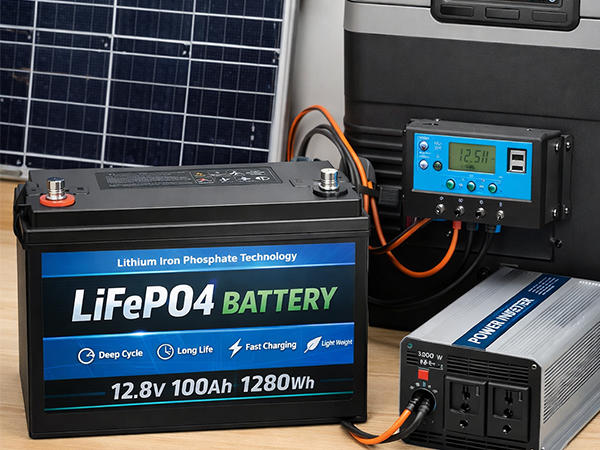
Part 1: What You Should Know About LiFePO4 Batteries
1. What Is a LiFePO4 Battery?
A Lithium Iron Phosphate battery, commonly known as LiFePO4 (LFP), is a type of lithium-ion battery known for its safety, long cycle life, efficiency, and stable voltage output.
LiFePO4 batteries feature:
High thermal stability
Long cycle life
Reliable safety performance
Low risk of thermal runaway
These characteristics make LiFePO4 batteries one of the safest and most durable lithium battery technologies available today.
2. Are LiFePO4 Batteries Safe?
Safety is a common concern among customers.
The chemical structure of LFP makes it stable under high temperatures or physical impact. It is less likely to experience combustion or explosion.
LiFePO4 batteries provide:
No risk of acid leakage
No harmful gas emissions
No hydrogen gas buildup caused by overcharging
Safety also depends on proper system design. A well-engineered battery should include a Battery Management System (BMS) that monitors voltage, current, and temperature to prevent overcharge, over-discharge, overcurrent, short circuit, and extreme temperature conditions.
3. How Do LFP Batteries Perform in Cold Weather?
Low temperatures are an important consideration for lithium batteries.
LFP batteries may experience reduced charging performance below 0°C (32°F).
This can be addressed by adding a low-temperature heating function or using low-temperature cells.
For cold regions such as Canada and Northern Europe, an intelligent battery system with built-in heating and low-temperature charging protection is recommended.
Part 2:Key Considerations When Upgrading from Lead-Acid to LiFePO4
1.Voltage Compatibility
Before upgrading,check your system’s voltage compatibility.
For example:
*A 12V lead-acid battery typically has a resting voltage of 12.6–12.8V.
*Its charging voltage is usually 14.4–14.6V.
Ensure that your equipment and charging system are compatible with LiFePO4 voltage requirements before making the switch.
2.Charger Compatibility
Lead-acid chargers typically operate in three stages:constant current,constant voltage,and float charge.
LiFePO4 batteries require a charger specifically designed for lithium batteries.Using a compatible charger ensures:
*Full capacity charging
*Optimal performance
*Extended battery lifespan
Using an incorrect charger may prevent the battery from reaching full capacity or may shorten its service life.
3.Battery Management System(BMS)
LiFePO4 batteries come with a built-in BMS that protects against:
*Overcharge
*Over-discharge
*Overcurrent
*Short circuit
*Extreme temperatures
For cold climates such as Canada and Nordic countries,choose batteries with low-temperature charging protection or integrated heating systems.
3.Does a 12V 100Ah LiFePO4 Battery Last Longer Than a 12V 100Ah Lead-Acid Battery?
Yes.Although the labeled capacity appears the same,the usable capacity differs significantly.
Lead-acid batteries should typically be limited to a 50%Depth of Discharge(DoD)to preserve lifespan.
LiFePO4 batteries can safely operate at 80–100%DoD.
Usable Capacity Comparison:
*Lead-acid battery:approximately 50Ah usable capacity
*LiFePO4 battery:approximately 90Ah usable capacity
Runtime Example(10A Load):
*Lead-acid battery:50Ah÷10A=5 hours
*LiFePO4 battery:90Ah÷10A=9 hours
Under identical conditions,a LiFePO4 battery can deliver approximately 80%longer runtime compared to a lead-acid battery.
4.Performance Advantages
Comparison Item | Lead-Acid Battery | LFP Battery |
Cycle Life | 300–500 cycles | 2,000–4,000 cycles |
Charging Efficiency | 70–80% | >95% |
Maintenance | Requires water refilling | Maintenance-free |
Weight | Heavy | 30–50%lighter |
Safety | Acid leakage risk | High thermal stability |
Total Cost | Lower upfront | Lower long-term |
Additional benefits of LiFePO4 batteries include:
*Stable voltage output during discharge
*Faster charging(over 95%efficiency vs.70–80%for lead-acid)
*Significantly longer service life(2,000–4,000+cycles vs.300–500 cycles)
*30–50%weight reduction
*Maintenance-free operation
*No acid leakage or gas emissions
5.Total Cost of Ownership
Although LiFePO4 batteries have a higher initial purchase cost,their longer lifespan,minimal maintenance requirements,higher efficiency,and extended runtime significantly reduce overall operating costs in the long term.
Conclusion
For businesses and consumers across Europe and North America,LiFePO4 batteries represent the modern standard for energy storage technology.
If you have further questions about LiFePO4 battery packs,feel free to contact us for more information.



 E-mail


 +86 13510702894