



18650 vs 21700 vs LFP eBike Battery OEM Comparison Guide
With the rapid growth of electric bicycles (eBike), electric cargo bikes, and smart mobility solutions, 18650, 21700, and LFP (Lithium Iron Phosphate) battery cells have become the mainstream choices for OEM battery customization.
For eBike manufacturers, brands, and bulk buyers, selecting the right battery technology directly affects range, weight, safety, cost, certification, and product competitiveness.
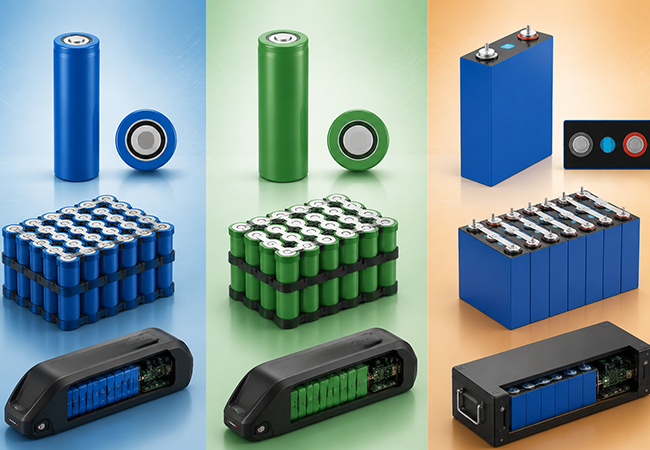
1. Basic Introduction of 18650, 21700 and LFP Battery Cells
| Battery Type | 18650 Lithium Cell | 21700 Lithium Cell | LFP Lithium Cell |
|---|---|---|---|
| Size | 18mm × 65mm | 21mm × 70mm | Prismatic / Cylindrical / Pouch |
| Chemistry | NMC / NCA / Li-ion | NMC / NCA | LiFePO4 |
| Nominal Voltage | 3.6V-3.7V | 3.6V-3.7V | 3.2V |
| Cell Capacity | 2000-3500mAh | 4000-6000mAh | 50Ah-320Ah |
| OEM Applications | eBike, power tools | High-performance eBike | Industrial vehicles, eBike, energy storage |
2. Energy Density Comparison
Energy density determines how much power a battery can store at the same weight.
| Battery Type | Energy Density Range |
|---|---|
| 18650 NMC | Around 180-260Wh/kg |
| 21700 NMC | Around 220-280Wh/kg |
| LFP | Around 120-180Wh/kg |
Why 21700 Has Advantages
Compared with 18650 cells, 21700 batteries offer:
✔ Higher capacity per cell
✔ Fewer cells required for the same battery capacity
✔ Simplified PACK structure
✔ Fewer welding points
✔ Improved space utilization
Example:
48V 15Ah eBike Battery
18650 Solution
13S5P configuration
65 cells
Higher assembly complexity
21700 Solution
13S3P configuration
39 cells
More compact battery design
For lightweight city eBikes, folding bikes, and mountain bikes, 21700 battery packs provide better design flexibility.
3. Cycle Life Comparison
Battery lifespan is a key factor for OEM customers.
| Battery Type | Cycle Life |
|---|---|
| 18650 NMC | 500-1000 cycles |
| 21700 NMC | 800-1500 cycles |
| LFP | 2000-5000 cycles |
LFP Battery Life Advantages
LFP batteries feature:
✔ Stable crystal structure
✔ Better thermal stability
✔ Excellent deep-cycle performance
✔ Slower capacity degradation
Therefore, LFP batteries are widely used in:
Commercial electric vehicles
Delivery eBikes
AGV robots
Industrial equipment
4. Safety Performance Comparison
Safety is a critical factor for outdoor electric mobility applications.
| Feature | 18650 | 21700 | LFP |
|---|---|---|---|
| Thermal Stability | Medium | Medium-Good | Excellent |
| High Temperature Performance | Average | Good | Excellent |
| Overcharge Resistance | Average | Good | Excellent |
| Chemical Safety | Depends on design | Depends on design | Naturally safer |
Due to its stable chemistry, LFP batteries are preferred for:
Hot climate regions
Long operating hours
Commercial fleet applications
5. OEM Manufacturing Cost Comparison
Battery cost is influenced by more than cell price. It also includes:
PACK structure
Number of cells
Welding process
BMS cost
Production efficiency
| Battery Type | OEM Cost Level |
|---|---|
| 18650 | ⭐⭐⭐ Cost-effective |
| 21700 | ⭐⭐⭐⭐ Medium |
| LFP | ⭐⭐⭐⭐ Medium-high |
Advantages of 18650 Battery Packs
18650 solutions are suitable for:
Entry-level eBikes
Large-volume production
Price-sensitive markets
Applications include:
European commuter bikes
Southeast Asian electric bikes
Shared mobility vehicles
6. Battery Weight and Space Utilization
Battery weight directly affects riding experience.
Example:
48V 20Ah Battery Pack
18650 Solution
More cells required
More welding points
Larger internal structure
21700 Solution
Fewer cells required
Higher capacity per cell
More compact design
Reduced PACK complexity
LFP Solution
Advantages:
✔ Long service life
✔ High safety level
Limitations:
Higher weight for the same capacity
7. Recommended Applications
Urban Commuter eBike
Recommended: 21700 NMC Battery
Advantages:
✔ Lightweight design
✔ Longer riding range
✔ Suitable for premium eBike models
✔ Flexible frame integration
Mountain Electric Bike (MTB)
Recommended: High-rate 21700 Battery Cells
Features:
High discharge capability
Strong acceleration performance
Better climbing power
Electric Cargo Bike (E-Cargo)
Recommended: LFP Battery
Reasons:
✔ Long operating time
✔ High cycle life
✔ Excellent safety performance
Delivery eBike
Recommended: LFP Battery
Delivery vehicles usually experience:
Daily deep discharge
Frequent charging
Long working hours
LFP technology helps extend battery service life.
Entry-Level Electric Bicycle
Recommended: 18650 NMC Battery
Advantages:
✔ Competitive cost
✔ Mature supply chain
✔ Easy maintenance
8. OEM Customization Comparison
| Feature | 18650 | 21700 | LFP |
|---|---|---|---|
| OEM Maturity | Excellent | Excellent | Excellent |
| Small Batch Customization | Excellent | Excellent | Excellent |
| High Capacity PACK | Medium | Excellent | Excellent |
| Lightweight Design | Medium | Excellent | Limited |
| Long Life Applications | Medium | Good | Excellent |
9. BMS Configuration Recommendations
Regardless of battery chemistry, a reliable Battery Management System (BMS) is essential.
Standard BMS Functions
Overcharge protection
Over-discharge protection
Over-current protection
Short-circuit protection
Temperature protection
Smart BMS Functions
Supports:
CAN communication
UART
RS485
Bluetooth APP monitoring
SOC display
Fault recording
Suitable for:
Premium eBikes
Smart mobility products
Commercial fleet management
10. Battery Certification Requirements
OEM eBike batteries for global markets usually require:
European Market
CE
EN IEC 62133-2
EN50604-1
UN38.3
RoHS
EU Battery Regulation (EU) 2023/1542
United States Market
UL2271
UL2054
UN38.3
Japan Market
PSE
South Korea Market
KC
Working with an experienced OEM battery manufacturer helps brands complete certification requirements and shorten product launch cycles.
11. OEM Battery Selection Recommendations
For Low-Cost Mass Production
Choose:
✅ 18650 NMC Battery Pack
Best for:
Entry-level eBikes
Cost-focused markets
For Premium Lightweight eBikes
Choose:
✅ 21700 NMC Battery Pack
Best for:
Long-range eBikes
Mountain bikes
High-performance electric bicycles
For Commercial and Long-Life Applications
Choose:
✅ LFP Battery Pack
Best for:
Delivery fleets
Cargo bikes
Industrial vehicles
Daily heavy-use applications
12. 18650 vs 21700 vs LFP Summary Comparison
| Category | 18650 | 21700 | LFP |
|---|---|---|---|
| Energy Density | ⭐⭐⭐⭐ | ⭐⭐⭐⭐⭐ | ⭐⭐⭐ |
| Safety | ⭐⭐⭐ | ⭐⭐⭐ | ⭐⭐⭐⭐⭐ |
| Cycle Life | ⭐⭐⭐ | ⭐⭐⭐⭐ | ⭐⭐⭐⭐⭐ |
| Cost Advantage | ⭐⭐⭐⭐⭐ | ⭐⭐⭐⭐ | ⭐⭐⭐ |
| Lightweight Design | ⭐⭐⭐ | ⭐⭐⭐⭐⭐ | ⭐⭐ |
| Commercial Applications | ⭐⭐⭐ | ⭐⭐⭐⭐ | ⭐⭐⭐⭐⭐ |
Conclusion
For eBike OEM battery solutions:
18650 batteries remain a mature and cost-effective choice for large-scale production.
21700 batteries are becoming a popular solution for high-performance eBikes due to their balance of energy density and lightweight design.
LFP batteries are ideal for commercial applications requiring long lifespan, safety, and reliable daily operation.
As the eBike industry continues moving toward longer range, intelligent systems, and commercial fleet applications, 21700 high-energy-density batteries and LFP long-life battery packs will become key trends in OEM electric bicycle battery solutions.

 E-mail


 +86 13510702894