



Why LiFePO₄ Batteries Are Safer Than NMC Lithium Batteries?
As lithium battery applications continue expanding across energy storage, electric vehicles, industrial equipment, AGV robots, forklifts, and marine systems, battery safety has become one of the most important factors for customers and manufacturers.
Among different lithium battery technologies, LiFePO₄ batteries (Lithium Iron Phosphate batteries) are widely recognized for their excellent safety performance compared with NMC lithium batteries (Nickel Manganese Cobalt batteries).
Although NMC batteries offer higher energy density, LiFePO₄ batteries provide superior thermal stability, longer cycle life, and lower risk of thermal runaway, making them an ideal choice for applications requiring long-term reliability and safety.
What Makes LiFePO₄ Batteries Safer?
Battery safety mainly depends on material stability, thermal management, manufacturing quality, and battery protection systems.
The biggest advantage of LiFePO₄ batteries comes from their stable cathode material structure.
1. More Stable Chemical Structure
LiFePO₄ batteries use lithium iron phosphate as the cathode material. The strong phosphorus-oxygen chemical bond creates a highly stable crystal structure.
Even under extreme conditions such as:
Overcharging
High temperature exposure
Short circuits
Mechanical damage
LiFePO₄ cells are less likely to release oxygen, reducing the possibility of combustion.
In comparison, NMC batteries contain nickel, manganese, and cobalt materials. While they provide higher energy density, their chemical structure is more sensitive to high temperatures and requires stricter battery management.
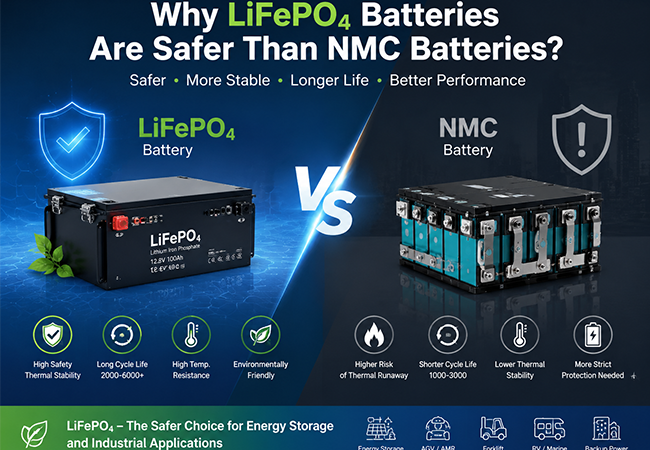
LiFePO₄ vs NMC Battery Safety Comparison
| Feature | LiFePO₄ Battery | NMC Lithium Battery |
|---|---|---|
| Thermal Stability | Excellent | Good |
| Risk of Thermal Runaway | Lower | Higher |
| High Temperature Performance | Strong | Moderate |
| Cycle Life | 2,000-6,000+ cycles | 1,000-3,000 cycles |
| Energy Density | Medium | High |
| Safety Level | ⭐⭐⭐⭐⭐ | ⭐⭐⭐⭐ |
For applications where safety and reliability are priorities, LiFePO₄ batteries have a clear advantage.
2. Higher Thermal Runaway Resistance
Thermal runaway is one of the biggest safety concerns in lithium batteries.
It occurs when internal battery temperature rises uncontrollably, causing chemical reactions that may generate heat, gas, or fire.
LiFePO₄ batteries have a higher thermal stability threshold because their cathode materials are more resistant to decomposition.
This means:
Lower heat generation
Slower temperature increase
Reduced risk of fire propagation
Better safety performance in large battery systems
This is especially important for battery packs used in:
Energy storage systems
Electric forklifts
AGV robots
Industrial vehicles
Backup power systems
3. Longer Cycle Life Improves Long-Term Safety
Battery aging can increase internal resistance, generate more heat, and reduce overall safety.
One major advantage of LiFePO₄ batteries is their long service life.
A high-quality LiFePO₄ battery can typically achieve:
2,000+ charge cycles
5,000+ cycles in optimized applications
Compared with traditional lithium battery chemistries, LiFePO₄ batteries maintain capacity better during long-term operation.
For businesses, this means:
Fewer battery replacements
Lower maintenance costs
More stable equipment operation
Higher return on investment
Why Are More Industries Choosing LiFePO₄ Batteries?
Energy Storage Systems
Safety is the top priority for residential and commercial energy storage.
LiFePO₄ batteries provide:
Stable operation
Long lifespan
High safety performance
Reliable energy supply
They are becoming a preferred solution for solar energy storage and backup power applications.
AGV and AMR Robot Batteries
Automated warehouses require batteries that can support frequent charging and discharging.
LiFePO₄ battery packs are suitable for AGV and AMR applications because they offer:
High cycle life
Stable voltage output
Fast charging capability
Low maintenance requirements
Electric Forklift Batteries
Compared with traditional lead-acid batteries, LiFePO₄ forklift batteries provide:
Longer operating time
Faster charging
No regular water maintenance
Better workplace safety
This makes lithium forklift batteries increasingly popular in logistics and manufacturing industries.
Golf Cart and Marine Battery Applications
For golf carts, RVs, and marine systems, battery safety is critical because equipment often operates in enclosed or remote environments.
LiFePO₄ batteries provide reliable power with improved safety and longer service life.
Does Higher Energy Density Mean Better Battery Performance?
Not always.
NMC batteries have higher energy density, which makes them suitable for applications requiring lightweight and long driving range.
However, battery selection depends on the application requirements.
| Application | Recommended Battery |
|---|---|
| Home Energy Storage | LiFePO₄ |
| Solar Storage | LiFePO₄ |
| UPS Backup Power | LiFePO₄ |
| AGV Robot | LiFePO₄ |
| Forklift | LiFePO₄ |
| Golf Cart | LiFePO₄ |
| Electric Vehicle | NMC / LiFePO₄ |
| Power Tools | NMC |
The best battery technology is the one that matches the specific application.
How Battery Management System (BMS) Improves LiFePO₄ Safety
A high-quality LiFePO₄ battery pack is not only about the cell chemistry. The Battery Management System (BMS) also plays a key role.
Advanced BMS functions include:
Overcharge protection
Over-discharge protection
Over-current protection
Temperature monitoring
Cell balancing
Communication functions such as CAN and RS485
Together with high-quality manufacturing processes, BMS technology ensures safer and more reliable battery operation.
Future Development of LiFePO₄ Battery Technology
With the global transition toward renewable energy and electrification, demand for safe lithium batteries continues to grow.
LiFePO₄ battery technology is expected to play a larger role in:
Renewable energy storage
Industrial automation
Electric transportation
Smart logistics
Backup power systems
The combination of safety, durability, and cost efficiency makes LiFePO₄ one of the most promising lithium battery technologies for future energy solutions.
FAQ About LiFePO₄ Battery Safety
1. Are LiFePO₄ batteries safer than NMC batteries?
Yes. LiFePO₄ batteries have better thermal stability and lower risk of thermal runaway compared with NMC lithium batteries.
2. Can LiFePO₄ batteries catch fire?
Like all lithium batteries, LiFePO₄ batteries can be damaged under extreme conditions. However, their stable chemistry significantly reduces fire risk.
3. How long do LiFePO₄ batteries last?
High-quality LiFePO₄ batteries can typically last 2,000 to 6,000+ cycles depending on usage conditions.
4. Are LiFePO₄ batteries suitable for industrial applications?
Yes. Their long cycle life, safety performance, and reliability make them ideal for AGV, AMR, forklifts, energy storage, and industrial equipment.
5. Which is better: LiFePO₄ or NMC battery?
It depends on the application. LiFePO₄ is better for safety and lifespan, while NMC is better for high energy density and lightweight designs.
Conclusion
LiFePO₄ batteries have become one of the safest lithium battery solutions because of their stable chemical structure, excellent thermal performance, and long cycle life.
While NMC batteries remain valuable for applications requiring maximum energy density, LiFePO₄ batteries are the preferred choice for energy storage, industrial equipment, and other scenarios where safety and reliability are the highest priorities.
As global demand for safer energy solutions continues growing, LiFePO₄ battery technology will continue powering the future of sustainable energy.



 E-mail


 +86 13510702894