



How to Select a Marine Battery for Electric Boat Motors: Complete Guide 2026
The marine industry is gradually adopting electric propulsion systems for fishing boats, recreational vessels, trolling motors, autonomous boats, and other water-based equipment. Battery technology plays an important role in electric marine systems because it directly affects operating time, power supply stability, charging requirements, and system design.
Selecting a suitable marine battery requires consideration of multiple factors, including:
Battery chemistry
Voltage configuration
Capacity requirements
Continuous discharge current
Environmental protection
Battery management system (BMS)
Certification requirements
Traditional lead-acid batteries have been used in marine applications for many years. With the development of lithium battery technology, LiFePO₄ (Lithium Iron Phosphate) batteries are being applied in electric boat systems due to their stable chemical characteristics, cycle performance, and suitability for deep-cycle operation.
This guide explains the key factors involved in selecting a marine battery for electric boat motors, including battery types, capacity calculation, protection features, and OEM battery solutions.
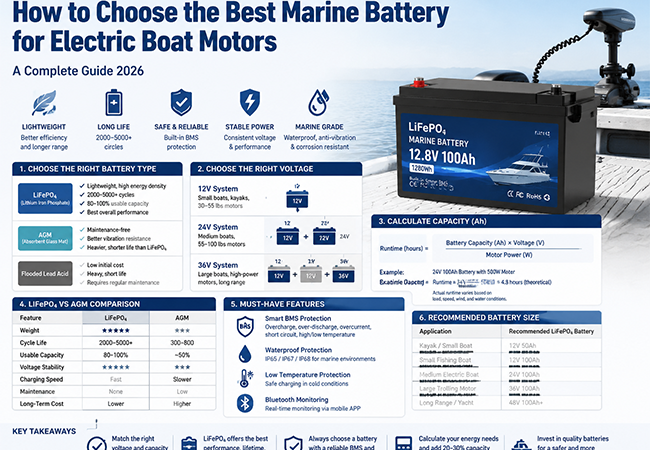
1. Battery Requirements for Electric Boat Motors
Electric boat motors require a battery system designed for continuous power supply rather than short-duration starting power.
A marine propulsion battery generally needs to support:
Continuous current output
Repeated charging and discharging cycles
Stable voltage operation
Outdoor environmental conditions
Vibration and moisture exposure
A suitable battery system should match the motor specifications and operating conditions of the vessel.
The main battery types used in marine applications include:
Flooded lead-acid batteries
AGM deep-cycle batteries
LiFePO₄ lithium batteries
Each battery type has different characteristics related to capacity, weight, maintenance, and operating requirements.
2. Flooded Lead-Acid Batteries for Marine Applications
Flooded lead-acid batteries are traditional energy storage products used in many marine systems.
Main characteristics:
Mature battery technology
Available supply chain
Simple charging requirements
Suitable for basic marine power applications
However, users need to consider:
Battery weight
Maintenance requirements
Discharge depth limitations
Charging time
Lead-acid batteries are commonly used where initial equipment cost and simple system requirements are important factors.
For electric propulsion systems requiring frequent operation, battery capacity planning and maintenance requirements should be evaluated carefully.
3. AGM Deep Cycle Batteries
AGM (Absorbent Glass Mat) batteries are sealed lead-acid batteries designed for deep-cycle applications.
Features include:
Sealed structure
Maintenance-free operation
Vibration resistance
Suitable for marine environments
AGM batteries are used in applications such as:
Small boats
Auxiliary marine systems
Backup power equipment
When selecting AGM batteries, users should consider:
Available installation space
Required operating time
Charging conditions
Battery replacement cycle
4. LiFePO₄ Marine Lithium Batteries
LiFePO₄ batteries are lithium battery systems commonly used in electric marine applications.
Typical application areas include:
Electric fishing boats
Trolling motors
Small electric vessels
Solar-powered marine systems
Marine robots
Auxiliary power systems
LiFePO₄ battery systems are designed with features such as:
Stable voltage characteristics
Deep-cycle capability
Integrated battery management systems
Lightweight battery pack design
These characteristics make LiFePO₄ suitable for various marine power applications.
5. LiFePO₄ Battery Characteristics in Marine Applications
5.1 Battery Weight Considerations
Battery weight affects vessel design, installation, and transportation.
Lithium battery packs use lithium cells with a compact structure, allowing battery manufacturers to design different capacity configurations according to vessel requirements.
Weight considerations are important for:
Portable fishing boats
Kayaks
Small electric vessels
Mobile marine equipment
A suitable battery design should balance capacity, installation space, and vessel requirements.
5.2 Battery Capacity and Usable Energy
Battery capacity is usually measured in ampere-hours (Ah).
However, actual available energy depends on:
Depth of discharge
Battery management settings
Operating temperature
Load conditions
Example:
A 12V 100Ah battery:
Energy calculation:
12V × 100Ah = 1200Wh
The actual operating time depends on the motor power consumption.
Factors affecting runtime include:
Motor output
Boat weight
Sailing speed
Water conditions
Weather conditions
Selecting appropriate battery capacity requires matching the battery specifications with the expected operating requirements.
5.3 Voltage Stability During Operation
Electric motors require a stable power supply during operation.
Battery voltage characteristics influence:
Motor output
Speed control
Energy consumption
LiFePO₄ batteries maintain a relatively stable discharge voltage during most of the discharge cycle, supporting consistent power delivery for electric motor systems.
6. Selecting Battery Voltage for Electric Boat Motors
Battery voltage should match the motor controller and motor specifications.
Common marine battery voltage systems include:
12V Marine Battery System
Suitable applications:
Small fishing boats
Kayaks
Small trolling motors
Common battery configurations:
12V 50Ah
12V 100Ah
24V Marine Battery System
Suitable applications:
Medium electric boats
Higher-power trolling motors
Longer operating requirements
Configuration example:
Two 12V batteries connected in series:
12V + 12V = 24V
Common configuration:
24V 100Ah LiFePO₄ battery pack
36V Marine Battery System
Suitable applications:
Larger trolling motors
Commercial fishing applications
Extended operation requirements
Configuration example:
Three 12V batteries connected in series:
12V + 12V + 12V = 36V
7. How to Calculate Marine Battery Capacity
Battery capacity selection depends on:
Motor power
Operating hours
Vessel size
Operating environment
The basic formula:
Battery Energy (Wh) = Voltage (V) × Capacity (Ah)
Example:
24V 100Ah battery:
24V × 100Ah = 2400Wh
If an electric motor consumes 500W:
2400Wh ÷ 500W ≈ 4.8 hours
The actual runtime may vary because of:
Speed settings
Boat load
Water resistance
Temperature
Battery condition
A capacity margin should be considered during system design.
8. Battery Discharge Current and BMS Selection
Electric boat motors require sufficient current output during operation.
Important parameters include:
Continuous discharge current
Peak discharge current
BMS current rating
Typical reference:
| Application | BMS Current Range |
|---|---|
| Small 12V motor | 40A–60A |
| Medium 24V system | 80A–100A |
| High-power marine system | 100A+ |
A battery management system provides protection functions including:
Overcharge protection
Over-discharge protection
Overcurrent protection
Short circuit protection
Temperature monitoring
9. Marine Lithium Battery Protection Features
9.1 Smart Battery Management System
A smart BMS can monitor:
Voltage
Current
Temperature
Remaining capacity
Charging status
Communication options include:
Bluetooth
CAN
RS485
UART
These functions allow integration with marine control systems and monitoring platforms.
9.2 Waterproof Battery Housing
Marine environments involve:
Water exposure
Humidity
Salt spray
Mechanical vibration
Battery enclosure design should consider:
Waterproof sealing
Corrosion resistance
Structural protection
Common protection ratings:
IP65
IP67
IP68
The required protection level depends on the installation environment.
9.3 Temperature Protection
Temperature management is important for lithium battery operation.
Battery systems may include:
Temperature sensors
Charging temperature protection
Discharge temperature monitoring
These functions help maintain battery operation under different environmental conditions.
10. Marine Battery Configuration Examples
| Application | Battery Configuration |
|---|---|
| Small Kayak | 12V 50Ah LiFePO₄ |
| Fishing Boat | 12V 100Ah LiFePO₄ |
| Electric Boat | 24V 100Ah LiFePO₄ |
| Large Trolling Motor | 36V Battery System |
| Marine Equipment | Customized Battery Pack |
The final battery configuration should be selected according to:
Motor specifications
Required operating time
Installation space
Charging system
11. LiFePO₄ and AGM Battery Comparison
| Parameter | LiFePO₄ | AGM |
|---|---|---|
| Battery Structure | Lithium iron phosphate cells | Lead-acid AGM cells |
| Weight | Lithium pack design | Lead-based structure |
| Cycle Performance | Suitable for repeated cycling | Suitable for standard cycling |
| Maintenance | Low maintenance | Low maintenance |
| Charging Method | LiFePO₄ charging profile | AGM charging profile |
| Application | Electric propulsion systems | Marine auxiliary systems |
Both battery types can be used in marine applications depending on system requirements.
12. Selecting an OEM Marine Battery Supplier
For boat manufacturers, distributors, and system integrators, battery supplier evaluation should include:
Cell Selection
Important factors:
Cell quality control
Cell consistency
Supply stability
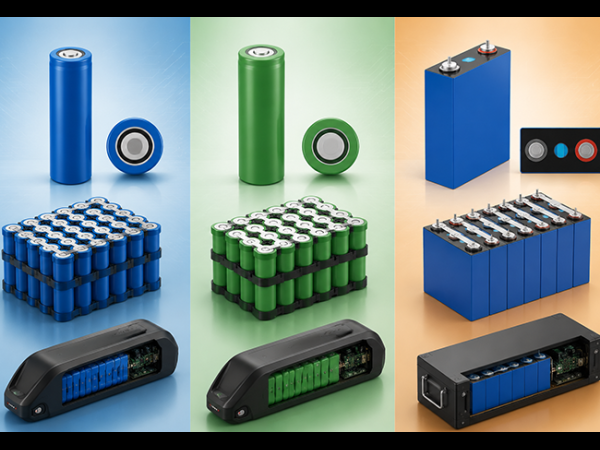
Common lithium battery cell formats include:
Cylindrical cells
Prismatic cells
Pouch cells
Manufacturing Process
A battery manufacturer should have:
Cell sorting process
Battery assembly equipment
Welding technology
Aging testing procedures
Quality inspection system
Certification Requirements
Marine lithium battery products may require:
UN38.3
CE
IEC62133
RoHS
MSDS
Certification requirements depend on the target market and application.
13. Future Development of Marine Battery Systems
Electric marine systems are developing toward:
Intelligent Battery Monitoring
Future battery systems may include:
Remote monitoring
Data communication
Battery status analysis
Modular Battery Design
Modular battery systems allow different voltage configurations:
12V
24V
36V
48V
Customized Battery Solutions
OEM battery manufacturers can provide customized designs based on:
Voltage requirements
Capacity specifications
Communication protocols
Mechanical dimensions
Application environment
FAQ: Marine Battery for Electric Boat Motors
Q1: Can automotive batteries be used for electric boat motors?
Automotive starter batteries are designed for short-term starting applications. Electric boat motors require batteries designed for continuous discharge operation.
Q2: How long can a 100Ah marine lithium battery operate?
Operating time depends on:
Motor power
Battery voltage
Boat load
Operating speed
Environmental conditions
Battery runtime should be calculated according to the complete system design.
Q3: Are LiFePO₄ batteries suitable for marine applications?
LiFePO₄ batteries are used in marine applications because of their stable chemical properties, cycle characteristics, and integrated protection systems.
Q4: What charger is required for a marine lithium battery?
A charger with LiFePO₄ charging parameters should be used to match the battery chemistry.
Q5: Can marine lithium batteries be customized?
OEM manufacturers can customize battery systems according to:
Voltage
Capacity
Size
BMS functions
Communication requirements
Conclusion
Selecting a marine battery for an electric boat motor requires evaluation of battery chemistry, voltage, capacity, discharge current, protection functions, and operating conditions.
LiFePO₄ battery systems are used in many electric marine applications due to their stable operating characteristics and suitability for repeated charging and discharging cycles.
For electric boat manufacturers, marine equipment companies, and battery distributors, customized lithium battery solutions can support different vessel designs and application requirements.


 E-mail


 +86 13510702894