



How to Maintain LiFePO4 Battery: Complete Guide to Extending Lithium Iron Phosphate Battery Life
Lithium Iron Phosphate batteries, commonly known as LiFePO4 batteries, have become one of the most popular energy storage solutions for electric vehicles, industrial equipment, renewable energy systems, marine applications, and robotics.
Compared with traditional lead acid batteries, LiFePO4 batteries provide significant advantages, including:
Longer cycle life
Higher energy efficiency
Better safety performance
Faster charging capability
Lower maintenance requirements
Although LiFePO4 batteries are designed for durability and reliability, proper maintenance is still essential to achieve maximum performance and extend battery lifespan.
A well-maintained LiFePO4 battery pack can deliver thousands of charge and discharge cycles while maintaining stable performance.
This guide explains how to maintain LiFePO4 batteries, including charging methods, temperature management, storage recommendations, inspection procedures, and common mistakes to avoid.
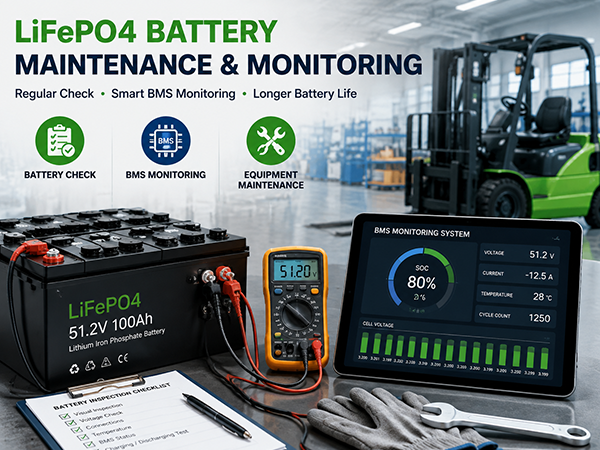
1. Why LiFePO4 Battery Maintenance Matters
Many users believe lithium batteries require no maintenance at all. While LiFePO4 batteries require much less maintenance than lead acid batteries, proper care can significantly improve their service life.
Battery performance is affected by:
Charging habits
Operating temperature
Discharge depth
Storage conditions
Charging equipment quality
For industrial applications such as forklifts, AGVs, AMRs, and electric vehicles, battery maintenance directly affects:
Equipment uptime
Operating costs
Production efficiency
Overall system reliability
2. Understand LiFePO4 Battery Characteristics Before Maintenance
Before learning how to maintain a LiFePO4 battery, it is important to understand its basic characteristics.
Long Cycle Life
A high-quality LiFePO4 battery can typically achieve:
| Battery Type | Average Cycle Life |
|---|---|
| Lead Acid Battery | 300-500 cycles |
| Lithium NMC Battery | 1000-2000 cycles |
| LiFePO4 Battery | 2000-5000+ cycles |
The actual lifespan depends on:
Battery design
Cell quality
Usage conditions
Charging strategy
Stable Voltage Performance
LiFePO4 batteries have a stable discharge platform, which provides:
Consistent equipment performance
Stable output power
Higher energy utilization
This makes them suitable for applications requiring reliable power delivery.
Built-in Battery Management System (BMS)
Most professional LiFePO4 battery packs include an intelligent BMS.
The BMS monitors:
Cell voltage
Current
Temperature
State of Charge (SOC)
State of Health (SOH)
Protection functions include:
Overcharge protection
Over-discharge protection
Over-current protection
Short-circuit protection
High and low-temperature protection
3. Use the Correct LiFePO4 Battery Charger
One of the most important maintenance rules is using the correct charger.
Avoid Using Lead Acid Chargers
Lead acid batteries and LiFePO4 batteries have different charging requirements.
Using an incorrect charger may cause:
Battery not fully charged
BMS protection activation
Reduced battery performance
Shortened lifespan
Always use:
LiFePO4 compatible charger
Correct charging voltage
Suitable charging current
Recommended Charging Voltage
Common LiFePO4 battery systems:
| Battery System | Nominal Voltage | Full Charge Voltage |
|---|---|---|
| 12V LiFePO4 | 12.8V | 14.6V |
| 24V LiFePO4 | 25.6V | 29.2V |
| 48V LiFePO4 | 51.2V | 58.4V |
Always confirm the battery specifications before charging.
4. Avoid Extreme Charging and Discharging Conditions
Although LiFePO4 batteries have excellent safety performance, avoiding extreme conditions helps maximize battery life.
Avoid Deep Discharge
Frequent discharge to very low levels may increase battery stress.
Recommended:
Maintain 20%-90% SOC for daily operation
Avoid leaving batteries completely empty
Recharge after heavy usage
Avoid Long-Term Full Charge Storage
Keeping a battery at 100% charge for extended periods may accelerate aging.
For long-term storage:
Recommended SOC:
40%-60%
5. Maintain Proper Operating Temperature
Temperature has a significant impact on lithium battery performance.
Recommended Temperature Range
Charging:
0°C to 45°C
Discharging:
-20°C to 60°C
Best Performance:
15°C to 35°C
High Temperature Protection
Continuous operation in high temperatures may cause:
Faster capacity degradation
Increased internal resistance
Reduced lifespan
Maintenance tips:
✔ Avoid direct sunlight
✔ Ensure proper ventilation
✔ Keep battery away from heat sources
Cold Temperature Operation
Low temperatures can reduce:
Charging efficiency
Available capacity
Output power
For cold environments, consider:
Low-temperature LiFePO4 batteries
Battery heating systems
Smart temperature-controlled BMS
Applications include:
Outdoor robots
Cold storage equipment
Electric vehicles in winter regions
6. Regularly Inspect LiFePO4 Battery Condition
Even though LiFePO4 batteries require minimal maintenance, regular inspection is recommended.
Check Battery Appearance
Inspect for:
Physical damage
Swelling or deformation
Cracks
Water exposure
Check Battery Connections
Inspect:
Power cables
Terminals
Connectors
Loose connections may cause:
Voltage drops
Heating
Power interruptions
This is especially important for:
Forklift batteries
Marine batteries
Industrial vehicles
7. Keep the Battery Clean and Dry
A clean battery environment helps maintain reliable operation.
Recommended:
Clean dust regularly
Keep terminals dry
Prevent moisture accumulation
Avoid:
Corrosive cleaning chemicals
High-pressure water directly on connectors
For industrial applications, batteries with IP65, IP67, or IP68 protection ratings provide additional environmental protection.
8. Proper LiFePO4 Battery Storage Guide
If the battery will not be used for an extended period, proper storage is important.
Recommended Storage Conditions
Store the battery:
At 40%-60% charge level
In a dry environment
Away from extreme temperatures
Avoid:
Fully discharged storage
High-temperature storage
Long-term full charging
Storage Inspection
For long-term storage:
Check the battery every:
3-6 months
Recommended actions:
Check voltage
Recharge if necessary
Inspect physical condition
9. LiFePO4 Battery Maintenance for Different Applications
Forklift LiFePO4 Battery Maintenance
Forklift batteries operate under demanding conditions.
Recommended maintenance:
Check connectors regularly
Monitor charging cycles
Review BMS data
Keep battery compartments clean
Benefits:
Higher warehouse efficiency
Reduced downtime
Lower maintenance cost
AGV and AMR Robot Battery Maintenance
Automated equipment requires stable battery performance.
Important factors:
SOC accuracy
Communication status
Charging frequency
Smart BMS solutions support:
CAN communication
RS485 communication
Remote monitoring
Golf Cart LiFePO4 Battery Maintenance
For golf carts:
Recommended:
Avoid complete discharge
Charge after regular use
Store properly during off-season
Advantages:
Longer driving range
Reduced battery replacement
Stable performance
Solar Energy Storage Battery Maintenance
Energy storage systems require:
Proper charge management
Temperature monitoring
Regular system inspection
LiFePO4 batteries are widely used because of:
Long cycle life
High safety
Reliable performance
10. Common LiFePO4 Battery Maintenance Mistakes
Mistake 1: Using the Wrong Charger
Solution:
Always use a charger designed for LiFePO4 batteries.
Mistake 2: Leaving Battery Empty for Long Periods
Solution:
Recharge before storage and maintain proper SOC.
Mistake 3: Ignoring Temperature Conditions
Solution:
Operate and store batteries within recommended temperature ranges.
Mistake 4: Opening Battery Packs Without Professional Support
LiFePO4 battery packs contain:
Battery cells
BMS
Electrical protection components
Unauthorized disassembly may create safety risks.
11. Best Practices to Extend LiFePO4 Battery Life
To maximize battery lifespan:
1. Charge Correctly
Use compatible chargers and proper charging settings.
2. Avoid Extreme SOC Conditions
Maintain reasonable charge levels.
3. Control Temperature
Prevent overheating and extreme cold exposure.
4. Perform Regular Inspection
Monitor battery condition and connections.
5. Use Smart BMS Monitoring
Track battery performance in real time.
FAQ: LiFePO4 Battery Maintenance
Q1: Do LiFePO4 batteries need maintenance?
LiFePO4 batteries require minimal maintenance compared with lead acid batteries, but regular inspection and proper charging practices help extend lifespan.
Q2: How long can a LiFePO4 battery last?
A quality LiFePO4 battery pack can typically last 2000-5000 cycles depending on usage conditions.
Q3: Can I leave my LiFePO4 battery charging overnight?
Yes, if the battery uses a reliable BMS and a compatible charger. However, long-term unnecessary charging should be avoided.
Q4: What is the best storage percentage for LiFePO4 batteries?
For long-term storage, maintaining approximately 40%-60% SOC is recommended.
Q5: Can LiFePO4 batteries work in extreme temperatures?
Yes, but performance depends on the battery design. Low-temperature heating systems and temperature-controlled BMS are recommended for harsh environments.
Conclusion
Proper maintenance is essential to maximize the performance and lifespan of LiFePO4 batteries.
By following correct charging practices, controlling operating temperatures, maintaining proper storage conditions, and performing regular inspections, users can ensure reliable battery performance for years.
Whether used in forklifts, AGVs, AMRs, electric vehicles, marine systems, or energy storage applications, a professionally designed LiFePO4 battery pack provides a reliable, efficient, and long-lasting power solution.
Choosing a trusted custom LiFePO4 battery manufacturer with advanced BMS technology, strict quality control, and OEM/ODM capabilities can further ensure your battery system delivers stable performance throughout its lifecycle.

 E-mail


 +86 13510702894