



Custom Industrial Battery Packs: Design, BMS, Testing and OEM/ODM Solutions
Industrial equipment often operates under conditions that are different from consumer electronics. AGVs, AMRs, forklifts, pallet trucks, cleaning machines, medical equipment, inspection robots, portable industrial devices and other systems may require specific battery dimensions, voltage, capacity, discharge current, communication protocols and protection functions.
For these applications, an industrial battery is not simply a collection of lithium cells. The battery pack needs to work as part of the complete equipment system.
Custom industrial battery pack development provides a way to match the battery with the equipment's electrical, mechanical and operating requirements. From cell selection and pack structure to BMS configuration, connectors, communication and testing, each part can be designed according to the application.
Yizhan Electronics provides custom lithium battery pack OEM and ODM services for industrial equipment. The development process covers requirement analysis, battery design, prototype sampling, testing and mass production.
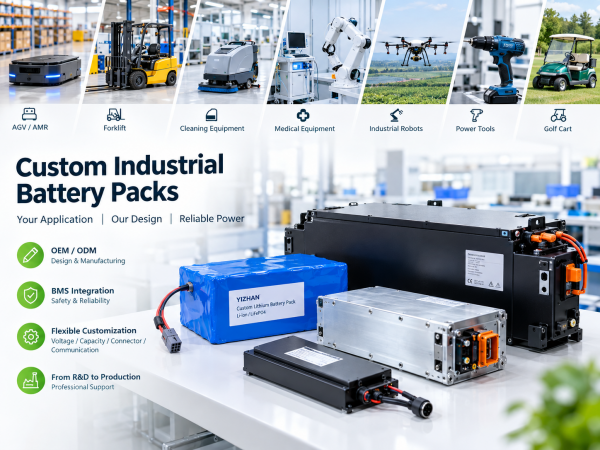
What Is an Industrial Battery Pack?
An industrial battery pack is a rechargeable battery system designed for equipment used in commercial, industrial or professional environments.
Compared with a basic battery module, an industrial battery pack may integrate:
Lithium-ion or LiFePO4 cells
Battery Management System (BMS)
Cell holders or structural components
Busbars and wiring
Connectors
Fuse and protection components
Temperature sensors
Communication interfaces
Battery enclosure
Charging interface
SOC/SOH monitoring functions
The actual configuration depends on the equipment and operating conditions.
For example, an AGV may require CAN communication with the vehicle controller, while a cleaning robot may require a compact battery enclosure and a specific connector. A forklift battery may focus on high-current discharge, cycle requirements and charging compatibility.
This is why industrial battery customization normally starts with the equipment requirements rather than selecting a battery from a standard catalog.
Industrial Applications for Custom Battery Packs
Custom lithium battery packs can be designed for a range of industrial and professional applications.
AGV and AMR Battery
Automated Guided Vehicles and Autonomous Mobile Robots require batteries that support repeated charging and discharging during daily operation.
Important design parameters may include:
System voltage
Battery capacity
Continuous discharge current
Peak current
CAN or RS485 communication
Battery dimensions
Charging method
Installation position
Operating temperature
Cycle requirements
For mobile robots, the battery enclosure also needs to match the available installation space.
Forklift and Pallet Truck Battery
Electric forklifts, pallet trucks, walkie stackers and tow tractors can use lithium battery systems designed around their electrical and mechanical requirements.
A custom battery project may involve:
24V, 36V, 48V or other system voltage
LiFePO4 cell configuration
High-current BMS
Anti-spark function
CAN communication
SOC display
Charging compatibility
Battery enclosure
Mechanical mounting
Temperature monitoring
The battery configuration should be validated against the motor controller, charger and vehicle electrical system.
Industrial Cleaning Equipment
Floor scrubbers, sweepers and autonomous cleaning robots require battery packs that support their operating schedules and installation structures.
The battery design can consider:
Required runtime
Motor load
Charging frequency
Available battery compartment
Connector type
BMS protection
Communication protocol
Waterproofing requirements
For robotic cleaning equipment, battery weight and physical dimensions can also affect the overall mechanical design.
Medical and Backup Power Equipment
Medical devices, portable equipment and backup power systems can require batteries with controlled voltage output, protection functions and monitoring.
Depending on the application, the battery pack may integrate:
Lithium-ion or LiFePO4 cells
BMS
Temperature monitoring
Overcharge protection
Over-discharge protection
Over-current protection
Short-circuit protection
Communication interface
Custom connectors
Battery requirements should be defined according to the electrical specifications and applicable product standards.
Industrial Robots and Automation Equipment
Robotic equipment may require a compact battery with a defined communication protocol and discharge profile.
The design process can consider:
Voltage → Capacity → Current → Dimensions → Communication → Charging → Protection
A battery pack can be developed around the equipment's actual power requirements instead of relying only on nominal voltage and capacity.
Key Parameters in Industrial Battery Customization
Before designing a battery pack, several technical parameters need to be confirmed.
1. Battery Voltage
Voltage determines the electrical compatibility between the battery and the equipment.
Common industrial battery systems include:
12V
24V
36V
48V
51.2V
72V
96V
Other voltage configurations can also be developed according to the cell configuration and equipment requirements.
The battery voltage should be compatible with the motor controller, charger and electrical architecture.
2. Battery Capacity
Capacity is normally expressed in Ah or Wh.
For example:
Energy (Wh) = Voltage (V) × Capacity (Ah)
If an industrial machine operates at 48V with a 50Ah battery:
48V × 50Ah = 2,400Wh
Actual available energy depends on the battery operating conditions, discharge current, temperature, BMS settings and other system factors.
3. Continuous and Peak Discharge Current
Battery capacity alone does not determine whether a battery can power industrial equipment.
The motor or actuator may require a high current during startup, acceleration or lifting.
Therefore, battery design should consider:
Continuous discharge current
Peak discharge current
Peak current duration
Motor power
Controller specifications
Load characteristics
The BMS current rating also needs to match the application.
4. Battery Dimensions
Industrial equipment often has a fixed battery compartment.
The available space should be measured before battery development.
Useful information includes:
Length
Width
Height
Mounting holes
Cable outlet position
Connector location
Battery insertion direction
Available clearance
Photos and drawings of the battery compartment can help engineers understand the installation requirements.
5. BMS Requirements
The BMS manages battery operation and provides protection functions.
Depending on the application, the BMS can support:
Overcharge protection
Over-discharge protection
Over-current protection
Short-circuit protection
Over-temperature protection
Under-temperature protection
Cell balancing
Voltage monitoring
Temperature monitoring
SOC calculation
Communication
Communication options may include CAN, UART and RS485.
For equipment that communicates with the battery, the BMS communication protocol needs to be matched with the controller or vehicle system.
Cell Selection for Industrial Battery Packs
Cell selection is part of the engineering process.
Depending on the application, battery packs may use cylindrical, prismatic or other lithium cell formats.
Common cell chemistries include:
NMC Lithium-Ion
NMC cells can be used where the application requires a combination of energy density, output capability and available installation space.
LiFePO4
LiFePO4 batteries are commonly considered for industrial equipment, energy storage and material-handling applications where cycle requirements and thermal characteristics are important.
The appropriate chemistry depends on the equipment, operating environment, required energy, current and safety requirements.
Cell selection should be based on verified electrical specifications and application conditions rather than cell brand alone.
Industrial Battery BMS Design
The BMS is an important part of a custom industrial battery.
A BMS can monitor individual cell voltage, pack voltage, current and temperature while controlling protection functions.
For an industrial battery project, engineers may need to define:
Number of series cells
Number of parallel cells
BMS voltage range
Continuous current
Peak current
Charge current
Temperature limits
Communication protocol
SOC calculation
Cell balancing
Protection thresholds
The BMS firmware may also need to communicate with the equipment controller.
For OEM projects, the communication protocol can be discussed during the engineering stage to establish the required data structure and functions.
Industrial Battery Pack Testing
Testing is an important part of battery pack production.
A custom industrial battery may go through several testing procedures, including:
Cell Inspection
Cells can be checked for voltage, internal resistance, capacity and consistency before assembly.
Battery Assembly Inspection
Engineers can inspect:
Cell arrangement
Welding
Wiring
Insulation
BMS connection
Connector installation
Structural components
Electrical Testing
The finished battery pack can be tested for:
Voltage
Capacity
Charge and discharge
Current
BMS protection
Communication
Cell voltage consistency
Aging Testing
Battery packs can undergo charging and discharging tests according to the defined production process.
Aging testing helps identify potential assembly or electrical issues before shipment.
Final Inspection
Final inspection can include appearance, dimensions, output voltage, BMS functions, protection functions and other project-specific requirements.
The exact testing items should be defined according to the battery design and customer specifications.
Industrial Battery OEM and ODM Process
A custom battery project normally involves several stages.
Step 1: Requirement Analysis
The customer provides information about:
Equipment type
Voltage
Capacity
Motor power
Continuous current
Peak current
Installation space
Connector
Communication protocol
Charging requirements
Quantity
Photos of the equipment and original battery can also be useful.
Step 2: Battery Design
Engineers determine the cell configuration, electrical architecture, BMS, wiring, enclosure and other components according to the requirements.
Step 3: Prototype Development
A sample battery is produced for installation and functional testing.
The sample can be checked with the customer's equipment to verify mechanical and electrical compatibility.
Step 4: Testing and Validation
The battery undergoes electrical, mechanical and functional testing based on the project requirements.
Any required design adjustments can be made before mass production.
Step 5: Mass Production
After the battery design and sample are confirmed, production can proceed according to the agreed specifications and quality requirements.
What Information Is Needed for a Custom Industrial Battery Quote?
To evaluate an industrial battery project, the following information is helpful:
Equipment or application
Required voltage
Required capacity
Motor or equipment power
Continuous discharge current
Peak discharge current
Battery dimensions
Connector type
Communication protocol
Charger information
Operating temperature
Sample quantity
Estimated annual quantity
If the project involves replacing an existing battery, customers can also provide photos of the original battery, label, connector, mounting structure and battery compartment.
This information allows engineers to evaluate the battery architecture before preparing a quotation.
Custom Industrial Battery Manufacturer
Yizhan Electronics focuses on custom lithium battery pack development and manufacturing for industrial equipment and other professional applications.
The company provides OEM and ODM battery services covering:
Battery pack design
Cell configuration
BMS design
Structural design
Prototype development
Sample production
Mass production
Battery testing
Custom connectors
Communication integration
Label and packaging customization
The development process connects R&D and manufacturing, allowing battery requirements to be reviewed from the initial design stage through production.
For industrial equipment manufacturers, system integrators and distributors, custom battery development can be used when a standard battery does not match the equipment's electrical or mechanical requirements.
Conclusion
Industrial battery customization involves more than selecting voltage and capacity. The battery needs to match the equipment's electrical system, installation space, load profile, charging method, communication requirements and operating environment.
A complete custom battery project can include cell selection, pack configuration, BMS development, structural design, communication integration, prototype testing and mass production.
By providing equipment specifications, battery dimensions, current requirements and application information at the beginning of the project, customers can give battery engineers the information needed to develop a suitable industrial battery solution.
For custom industrial lithium battery packs, OEM/ODM development and BMS-integrated battery systems, Yizhan Electronics can evaluate project requirements and develop a battery configuration based on the target equipment.
FAQ
What is an industrial custom battery pack?
It is a rechargeable battery system designed around the electrical, mechanical and operating requirements of industrial equipment.
Can you customize the voltage and capacity?
Yes. Battery voltage and capacity can be configured according to the equipment requirements and selected cell configuration.
Can the BMS be customized?
Yes. BMS parameters, protection functions and communication interfaces can be configured according to the application.
Can you develop a battery based on an existing battery?
Yes. Photos, dimensions, labels, connectors, mounting structures and electrical specifications of the existing battery can be used as reference information.
What industrial equipment can use custom lithium batteries?
Applications can include AGVs, AMRs, forklifts, pallet trucks, cleaning machines, robots, medical equipment, industrial automation equipment and other battery-powered systems.
What information should I provide for a battery quotation?
Voltage, capacity, equipment power, current requirements, battery dimensions, connector, communication protocol, charger information and estimated order quantity are useful starting points.

 E-mail


 +86 13510702894