



How to Choose a Forklift Battery Manufacturer?
Choosing a forklift battery manufacturer is an important decision for electric forklift manufacturers, warehouse operators, and material-handling equipment companies.
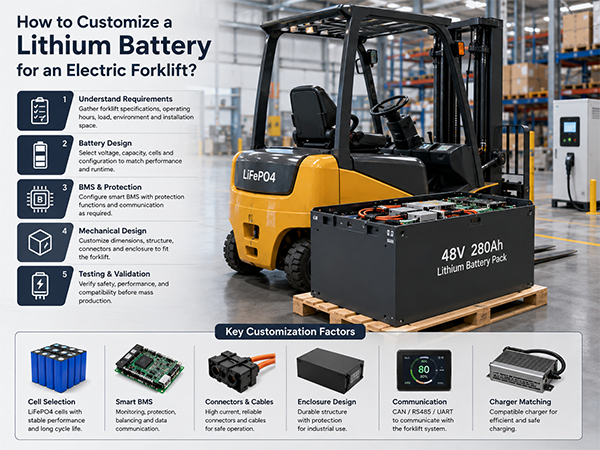
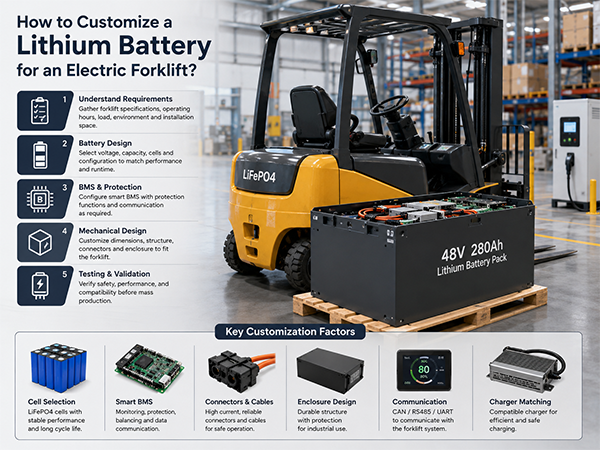
A forklift battery is not simply a power source. It needs to work with the forklift's motor, controller, charger, communication system, and mechanical structure. For lithium battery applications, the battery also includes cells, a Battery Management System (BMS), protection components, connectors, cables, enclosure, and charging control.
For this reason, comparing suppliers only by battery price may not provide enough information.
A suitable forklift battery manufacturer should be able to understand the forklift's operating requirements and develop a battery pack that matches the equipment.
This guide explains the main factors to consider when selecting a forklift battery manufacturer.
1. Check the Manufacturer's Battery Experience
The first factor to consider is whether the manufacturer has experience with industrial battery applications.
Forklift batteries have different requirements from batteries used in consumer electronics or small portable devices.
A manufacturer should understand factors such as:
High-current discharge
Frequent charging and discharging
Long operating hours
Heavy loads
Battery compartment limitations
Charging requirements
BMS communication
Industrial operating environments
Ask the manufacturer about previous applications involving:
Electric forklifts
Reach trucks
Electric pallet trucks
Stackers
Automated guided forklifts
Warehouse equipment
Other industrial vehicles
Application experience can help reduce compatibility problems during battery development.
2. Evaluate the Battery Chemistry
Different lithium battery chemistries have different characteristics.
For forklift applications, LiFePO4 is one option that manufacturers may consider, particularly for applications requiring repeated cycling.
When evaluating a forklift battery manufacturer, ask:
Which cell chemistry do you recommend?
Why is it suitable for the forklift?
What cell manufacturers are available?
What capacity options are available?
What are the recommended operating conditions?
How is the battery managed during charging and discharging?
The manufacturer should be able to explain the reasoning behind the battery selection rather than simply recommending a standard product.
3. Check Cell Quality and Consistency
Battery cells are the foundation of a lithium battery pack.
A manufacturer should have a defined process for incoming cell inspection and matching.
Important parameters can include:
Cell voltage
Internal resistance
Capacity
Appearance
Production batch
Cell model
Manufacturing date
Cell consistency is particularly important when multiple cells are connected together.
A manufacturer with an established cell-sorting process can reduce variation between cells before pack assembly.
You can also ask whether the manufacturer can provide cell specifications and traceability information for the selected battery cells.
4. Look at Customization Capabilities
Forklifts have different battery compartments, electrical systems, and operating requirements.
A suitable manufacturer should be able to customize the battery according to the application.
Customization may include:
Electrical Design
Voltage
Capacity
Maximum discharge current
Charging current
Mechanical Design
Length
Width
Height
Weight
Enclosure
Mounting points
Electrical Interface
Connectors
Cables
Fuse
Contactor
Emergency disconnect
Communication
CAN
CAN FD
RS485
UART
A manufacturer that can customize these parameters can be more suitable for OEM forklift projects than a supplier that only provides standard battery packs.
5. Evaluate the BMS
The BMS is one of the most important parts of a lithium forklift battery.
A suitable BMS should monitor and manage key battery parameters, including:
Cell voltage
Pack voltage
Charging current
Discharging current
Temperature
SOC
SOH
Fault conditions
Depending on the application, protection functions may include:
Overcharge protection
Over-discharge protection
Over-current protection
Short-circuit protection
Over-temperature protection
Under-temperature protection
For forklift applications, communication can also be important.
A BMS with CAN or another compatible communication interface can transmit battery information to the forklift control system.
Before choosing a manufacturer, ask whether the BMS can be configured according to the forklift's control system.
6. Confirm Communication Compatibility
Modern electric forklifts may use battery communication to monitor battery status.
For example, the forklift controller may need information about:
State of charge
Battery voltage
Current
Temperature
Fault status
Remaining capacity
Charging status
If the forklift uses CAN communication, the battery manufacturer should be able to evaluate the communication protocol and perform compatibility testing.
Do not assume that two batteries with the same voltage and capacity are automatically interchangeable.
Communication compatibility should be verified before mass production.
7. Check Battery Testing Capabilities
Testing is an important part of battery manufacturing.
A forklift battery manufacturer should have appropriate testing procedures for the battery pack and its components.
Testing may include:
Electrical Testing
Capacity testing
Voltage testing
Internal resistance
Charging and discharging
BMS protection
Temperature Testing
Charging temperature
Discharging temperature
Temperature rise
High-temperature operation
Mechanical Testing
Vibration
Impact
Enclosure integrity
Connector stability
Communication Testing
CAN communication
SOC data
Fault information
Charging communication
The exact tests required depend on the battery design and intended application.
For OEM projects, it is useful to ask the manufacturer whether prototype batteries can be tested together with the actual forklift.
8. Review Relevant Certifications and Standards
Certification requirements depend on the battery design, destination market, transportation method, and application.
For industrial lithium batteries, manufacturers may need to consider standards and requirements such as:
IEC 62619
UN 38.3
CE-related requirements where applicable
RoHS where applicable
Local market requirements
IEC 62619 covers safety requirements and tests for secondary lithium cells and batteries used in industrial applications.
For transportation, UN 38.3 testing is commonly relevant to lithium battery shipments.
The important point is that certification should match the actual battery model and intended market.
Do not simply choose a manufacturer because it lists many certificates on its website. Ask for the relevant reports or certificates and confirm that they apply to the battery you are purchasing.
9. Inspect the Production Process
A battery manufacturer's production process can affect consistency and quality.
When evaluating a supplier, consider whether the factory has defined processes for:
Incoming material inspection
Cell sorting
Cell matching
Welding
BMS installation
Wiring
Pack assembly
Insulation
Functional testing
Aging
Final inspection
Packaging
For larger OEM projects, it can also be useful to understand whether the manufacturer has dedicated production lines and quality control procedures for different battery models.
A clear manufacturing process makes it easier to maintain consistent production between batches.
10. Ask About Aging and End-of-Line Testing
Battery packs should be tested after assembly.
Aging and end-of-line testing can help identify issues that may not be visible during visual inspection.
Depending on the battery design, testing can include:
Charging
Discharging
Voltage verification
BMS protection
Communication
Temperature monitoring
Capacity verification
Insulation testing
Ask the manufacturer how the battery is tested before shipment and whether test records can be provided.
11. Consider Battery Enclosure and Mechanical Design
Forklift batteries operate in industrial environments.
The battery enclosure may need to withstand:
Vibration
Mechanical impact
Dust
Moisture
Repeated installation and removal
The enclosure should also provide suitable protection for internal components.
For customized batteries, the manufacturer should consider:
Enclosure material
Structural strength
Battery compartment dimensions
Mounting method
Cable routing
Connector position
Service access
Cooling or ventilation requirements
Mechanical compatibility is just as important as electrical compatibility.
12. Evaluate Charging Compatibility
The battery and charger should be designed as a compatible system.
When selecting a manufacturer, ask whether it can support:
Battery charger matching
Charging voltage configuration
Charging current configuration
BMS-charger communication
Opportunity charging
Temperature-based charging protection
This is especially important for forklifts operating multiple shifts.
A warehouse may use opportunity charging during breaks instead of waiting for a complete discharge. In this situation, charging current, battery capacity, BMS configuration, and charging frequency should be considered together.
13. Consider Temperature Requirements
Not all forklifts operate in the same environment.
Applications may include:
Standard indoor warehouses
Outdoor logistics areas
Cold storage
Food distribution centers
Manufacturing facilities
High-temperature environments
Temperature requirements should therefore be discussed before battery production.
For cold-storage applications, the manufacturer may need to evaluate:
Low-temperature discharge
Low-temperature charging
Battery heating
Temperature sensors
BMS temperature limits
For high-temperature environments, thermal management and charging conditions may require additional evaluation.
14. Check Production Capacity
If you are an OEM forklift manufacturer, production capacity can become important as the project grows.
Ask about:
Monthly production capacity
Production line capacity
Lead time
Prototype capacity
Material availability
Quality control
Batch management
The supplier should be able to explain how it will move from prototype production to regular production.
This is particularly important when several forklift models require different battery configurations.
15. Evaluate Technical Support
Technical support can be important during battery customization.
A battery manufacturer should be able to communicate with the forklift engineering team about:
Electrical specifications
Battery dimensions
BMS parameters
CAN communication
Charger compatibility
Mechanical installation
Fault diagnosis
Battery testing
For OEM projects, technical communication should ideally begin before the purchase order is finalized.
A manufacturer that can provide drawings, specifications, communication information, and test documentation can make the integration process more manageable.
16. Compare Total Cost Instead of Battery Price Alone
The lowest initial battery price does not necessarily represent the lowest overall cost.
When comparing forklift battery manufacturers, consider:
Total Cost = Battery Cost + Charger Cost + Maintenance + Downtime + Replacement + Integration Cost
Other factors can also affect the total cost, including:
Charging frequency
Battery replacement requirements
Maintenance workload
Energy consumption
Warranty conditions
Technical support
Spare parts availability
For fleet operators, battery downtime can also affect warehouse productivity.
Therefore, the purchasing decision should consider the battery's expected operating conditions and lifecycle requirements.
17. Check After-Sales Support
Before selecting a manufacturer, understand how technical issues will be handled after delivery.
Ask about:
Warranty period
Warranty conditions
Technical support
Troubleshooting
Spare parts
BMS fault analysis
Replacement procedures
Remote support
For international customers, it can also be useful to understand the supplier's export experience and logistics support.
Clear after-sales procedures can make battery fleet management easier.
18. Questions to Ask a Forklift Battery Manufacturer
Before placing an order, you can use the following questions to compare manufacturers:
Battery
What battery chemistry do you recommend?
Which cell model will be used?
What voltage and capacity options are available?
What is the maximum continuous discharge current?
BMS
What BMS is used?
What protection functions are included?
Does it support CAN or RS485?
Can the parameters be customized?
Mechanical
Can the battery dimensions be customized?
Can the connector position be changed?
Can the enclosure be customized?
Can the battery weight be controlled?
Testing
What tests are performed before shipment?
Is capacity testing performed?
Is BMS communication tested?
Can the battery be tested with the actual forklift?
Certification
Which standards apply to the battery?
Is UN 38.3 available for transportation?
Are relevant safety test reports available?
Production
Where is the battery manufactured?
What is the production capacity?
What is the prototype lead time?
How is production quality controlled?
19. A Practical Checklist for Choosing a Forklift Battery Manufacturer
Before selecting a supplier, review the following areas:
Forklift application experience
Appropriate battery chemistry
Reliable cell sourcing
Cell inspection and matching
Custom voltage and capacity
Custom battery dimensions
BMS customization
Communication compatibility
Charger compatibility
Battery testing
Relevant certifications
Production capacity
Quality management
Technical support
Warranty and after-sales service
International shipping experience
A manufacturer that meets the technical requirements and can provide clear documentation is generally easier to evaluate than a supplier that only provides a product price.
Conclusion
Choosing a forklift battery manufacturer requires more than comparing battery specifications and prices.
For electric forklift applications, manufacturers and fleet operators should evaluate the complete battery system, including:
Battery chemistry
Cells
Voltage and capacity
BMS
Communication
Charger compatibility
Battery dimensions
Enclosure
Temperature management
Testing
Certifications
Production capability
Technical support
LiFePO4 can be considered for forklift applications that require repeated charging and discharging, but the battery should still be designed according to the actual forklift and operating environment.
For OEM forklift manufacturers and warehouse equipment companies, it is useful to involve the battery manufacturer during the equipment design stage. Providing detailed information about voltage, capacity, load, operating hours, charging method, installation space, and communication requirements can help create a battery pack that fits the application.
The right supplier is therefore not simply the company offering a battery at a certain price. It is a manufacturer that can provide a battery system compatible with the forklift's electrical, mechanical, operational, and safety requirements.

 E-mail


 +86 13510702894