



What Affects the Cost of Custom Battery Pack Development?
When developing a custom lithium battery pack, the total project cost includes several components. These may include battery cells, battery configuration, Battery Management System (BMS), enclosure design, engineering development, prototype production, testing, and certification.
For OEM and ODM customers developing electric bicycles, electric scooters, AGVs, AMRs, service robots, industrial equipment, or energy storage systems, understanding these cost factors helps with project budgeting and product planning.
A custom battery pack is designed according to the electrical, mechanical, and environmental requirements of the customer's equipment. Each project has its own technical specifications, material requirements, and manufacturing processes.
This article explains the main factors affecting custom battery pack development cost and the information required for preparing a project quotation.
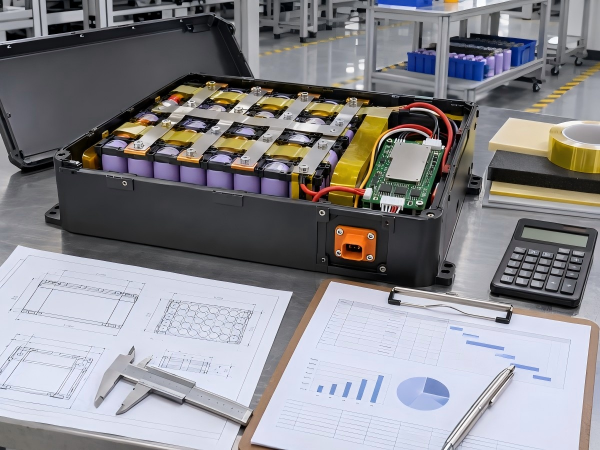
1. Battery Cell Selection and Configuration
Battery cells are a major component of lithium battery pack manufacturing cost.
Different cell chemistries, capacities, dimensions, brands, and electrical specifications have different purchasing prices.
Common lithium battery chemistries used in custom battery packs include:
Ternary Lithium-Ion Batteries
Ternary lithium-ion batteries use cathode materials containing nickel, manganese, and cobalt (NMC).
These cells are used in applications requiring specific energy density, voltage, and discharge performance.
Typical applications include:
Electric bicycles
Electric scooters
Electric motorcycles
Service robots
AGVs and AMRs
Portable industrial equipment
The purchasing cost of ternary lithium-ion cells depends on the cell manufacturer, model, capacity, discharge rating, supply conditions, and order quantity.
LiFePO4 Batteries
LiFePO4 (Lithium Iron Phosphate) cells are used in applications requiring defined cycle life, thermal stability, and energy storage capabilities.
Typical applications include:
Industrial equipment
AGVs and AMRs
Energy storage systems
Electric forklifts
Floor-cleaning machines
Solar energy storage
Prismatic LiFePO4 cells and cylindrical lithium-ion cells have different mechanical structures and assembly requirements.
Cell Brand and Performance Requirements
Cell selection is another factor in project costing.
Customers may specify cells from manufacturers such as EVE, Samsung, LG, or other approved suppliers.
The following parameters should be considered:
Cell manufacturer and model
Nominal capacity
Continuous discharge current
Peak discharge current
Internal resistance
Cycle life specification
Operating temperature
Cell availability
Purchasing quantity
For example, a 48V 50Ah battery pack designed for an industrial robot requires cell selection based on the equipment's continuous power demand and peak current requirements.
The selected cell model and series-parallel configuration determine the cell quantity and material cost.
2. Battery Voltage, Capacity, and Pack Configuration
Battery voltage and capacity determine the number of cells required for a battery pack.
The battery configuration is usually expressed as S and P:
S (Series): Determines the battery pack voltage.
P (Parallel): Determines the battery pack capacity and current capability.
Examples of common configurations include:
| Battery Configuration | Nominal Voltage | Typical Application |
|---|---|---|
| 10S Ternary Lithium-Ion | 36V | Electric mobility |
| 13S Ternary Lithium-Ion | 46.8V | 48V-class electric mobility |
| 14S Ternary Lithium-Ion | 51.8V | 52V-class electric mobility |
| 16S LiFePO4 | 51.2V | Energy storage |
| 8S LiFePO4 | 25.6V | 24V-class industrial equipment |
The actual nominal voltage depends on cell chemistry and cell specifications.
Increasing battery capacity generally requires additional parallel cells. This affects:
Battery cell quantity
Cell holders and insulation materials
Busbars and nickel strips
Electrical connections
Pack dimensions
Assembly labor
BMS current requirements
Customers should confirm the required voltage, capacity, and discharge current before battery pack development begins.
3. BMS Selection and Customization
The Battery Management System (BMS) is an essential component of a lithium battery pack.
The BMS monitors battery conditions and provides protection functions according to the battery specifications.
BMS cost depends on electrical specifications, hardware architecture, software functions, communication requirements, and customization scope.
Standard BMS
A standard BMS may support the following protection functions:
Overcharge protection
Over-discharge protection
Overcurrent protection
Short-circuit protection
Temperature protection
Cell balancing
The actual protection functions depend on the selected BMS model.
Customized BMS
Some OEM projects require application-specific BMS development.
Customization may include:
Continuous discharge current configuration
Peak current protection settings
Multiple NTC temperature sensors
CAN communication
UART communication
RS485 communication
SOC and SOH data reporting
LED battery indicators
Customized charging and discharging interfaces
Application-specific protection logic
For example, an AGV battery pack may require CAN communication to transmit voltage, current, temperature, SOC, and fault information to the equipment controller.
A robot battery project may also require a customized BMS PCB layout to fit the available installation space.
BMS Development Fees
When a project requires new BMS hardware or software development, additional engineering costs may apply.
These costs may include:
Circuit design
PCB layout
Component selection
Firmware development
Communication protocol integration
Prototype production
Functional testing
Design revisions
Customers should confirm whether the project requires a standard BMS or customized BMS development during the quotation stage.
4. Battery Enclosure and Mechanical Design
The battery enclosure affects material costs, tooling expenses, assembly processes, and engineering development costs.
Different applications require different battery shapes and installation structures.
Common enclosure materials include:
Plastic Enclosures
Plastic battery housings are commonly used for electric bicycles, electric scooters, portable equipment, and industrial battery packs.
The cost depends on:
Plastic material
Housing dimensions
Wall thickness
Structural design
Injection molding requirements
Surface finishing
Production quantity
If a customer requires a new injection mold, tooling costs need to be included in the development budget.
Aluminum Enclosures
Aluminum battery housings are used in industrial equipment, robots, energy storage systems, and applications requiring specific mechanical structures.
The cost depends on:
Aluminum material
Housing dimensions
CNC machining or extrusion processes
Welding and assembly
Surface treatment
Heat dissipation requirements
Customized Mechanical Structures
Some battery projects require customized mechanical structures to fit the customer's equipment.
Examples include:
Slide-in battery modules
Removable battery packs
Bottle-type e-bike batteries
Under-frame battery housings
Rack-mounted battery modules
Compact robot battery packs
Mechanical customization may require 3D modeling, structural evaluation, prototype machining, and design revisions.
These engineering activities are included in the project development scope.
5. Battery Connectors, Wiring, and Electrical Interfaces
Electrical interfaces are another factor affecting custom battery pack cost.
The battery pack may require different connectors for charging, discharging, communication, and signal transmission.
Common requirements include:
XT30, XT60, or XT90 connectors
Anderson connectors
Circular industrial connectors
Waterproof connectors
Customized power terminals
CAN communication connectors
Multi-pin signal connectors
Connector selection should consider rated current, voltage, temperature, installation space, mating cycles, and environmental protection requirements.
For industrial battery packs, customers may also require pre-charge circuits, secondary protection devices, contactors, fuses, or customized wiring harnesses.
These components and assembly processes contribute to the total project cost.
6. Certification and Testing Requirements
Certification and testing requirements affect the total cost of custom battery pack development.
Different target markets and applications may require different standards.
Examples include:
| Standard / Regulation | Application or Purpose |
|---|---|
| UN38.3 | Lithium battery transportation testing requirements |
| IEC 62133-2 | Safety requirements for portable sealed secondary lithium cells and batteries |
| EN 50604-1 | Safety requirements for lithium-ion battery systems used in light electric vehicle applications |
| UL 2271 | Safety requirements for batteries used in light electric vehicle applications |
| IEC 62619 | Safety requirements for industrial secondary lithium cells and batteries |
| IEC 60529 | Degrees of protection provided by enclosures (IP Code) |
The applicable standards depend on the battery product, intended application, destination market, and certification scope.
Certification-Related Costs
A certification project may involve:
Laboratory testing fees
Test samples
Technical documentation
Battery design evaluation
Component verification
Test failure analysis
Design modifications
Retesting
For custom battery packs, certification requirements should be discussed during the initial engineering stage.
If customers require a specific certification, the manufacturer needs to evaluate whether an existing tested design can be used as the project basis or whether a new certification project is required.
Certification results and certificates are subject to the relevant testing laboratory or certification body's evaluation.
7. Prototype Development and Engineering Costs
Before mass production, OEM projects may require prototypes for mechanical verification, electrical testing, and equipment integration.
Prototype development may involve:
Battery cell procurement
Customized BMS samples
Enclosure prototyping
Wiring harness preparation
Connector assembly
Firmware configuration
Functional testing
Mechanical fit testing
Some projects require prototype revisions because of changes in battery dimensions, connector positions, current requirements, or BMS functions.
Engineering costs may include design labor, prototype materials, sample assembly, testing, and development equipment.
For projects requiring new BMS hardware, injection molds, or custom mechanical structures, customers should confirm whether development fees are charged separately or included in the production quotation.
8. Production Quantity and MOQ
Production quantity affects material purchasing, production planning, tooling allocation, and manufacturing costs.
A custom battery pack may require dedicated materials, components, or manufacturing processes.
The following factors influence production pricing:
Total order quantity
Monthly production demand
Cell purchasing volume
Customized component MOQ
Enclosure tooling requirements
Assembly labor
Production testing
Packaging requirements
For example, a customer ordering 20 prototype battery packs has a different material purchasing and production arrangement from a project requiring 2,000 units.
For OEM projects, it is useful to separate prototype quantities, pilot production quantities, and mass production forecasts when requesting a quotation.
This allows the manufacturer to evaluate material procurement and production planning.
9. Packaging, Transportation, and Delivery Requirements
Battery transportation requires attention to packaging, shipping regulations, and destination requirements.
Depending on the battery type and shipping arrangement, additional costs may include:
UN38.3 test documentation
Dangerous goods packaging
Battery labeling
Export documentation
Freight charges
Insurance
Customs-related charges
Destination delivery arrangements
Shipping costs depend on battery specifications, shipment quantity, destination, transportation method, and applicable dangerous goods regulations.
For international OEM projects, customers should provide the delivery address and preferred Incoterms when requesting a quotation.
10. Information Required for a Custom Battery Pack Quotation
A clear technical specification helps define the project scope and avoid repeated design changes.
OEM customers should prepare the following information before contacting a battery manufacturer.
1. Electrical specifications
Provide nominal voltage, capacity, charging voltage, continuous discharge current, and peak discharge current.
2. Battery application
Explain whether the battery will be used in an e-bike, AGV, AMR, robot, forklift, or energy storage system.
3. Installation dimensions
Provide the available battery space, mounting method, and enclosure requirements.
4. BMS functions
Specify whether CAN, UART, RS485, temperature monitoring, SOC reporting, or customized protection functions are required.
5. Certification requirements
Identify the target market and applicable certification standards before design begins.
6. Production forecast
Share prototype quantity, initial order quantity, and estimated annual demand.
7. Development scope
Clarify whether the project includes separate BMS development fees, mechanical tooling costs, prototype costs, and certification expenses.
Providing these details allows the manufacturer to evaluate the project scope and prepare a quotation based on the actual requirements.
11. Custom Battery Pack Manufacturing at First Power
Dongguan Yizhan Electronics Technology Co., Ltd., operating under the First Power brand, provides OEM and ODM custom lithium battery pack development and manufacturing services.
Our battery pack business covers electric mobility, robotics, industrial equipment, and energy storage applications.
Our manufacturing and customization capabilities include:
Ternary lithium-ion and LiFePO4 battery pack development
Customized voltage and capacity configurations
Battery cell selection and sourcing
BMS hardware and software customization
CAN, UART, and RS485 communication
Customized plastic and aluminum enclosures
Waterproof connector integration
Battery pack assembly and testing
Technical documentation and certification project support
Each project is evaluated according to the customer's electrical specifications, mechanical requirements, application environment, and production plan.
The development scope and quotation are determined according to the confirmed technical requirements and manufacturing processes.
Conclusion
The cost of custom battery pack development depends on multiple factors, including battery cells, electrical configuration, BMS customization, enclosure design, connectors, certification, testing, and production quantity.
Understanding these factors helps OEM customers prepare project budgets and define technical requirements before development begins.
Whether you are developing an electric bicycle battery, an AGV battery module, a service robot battery, or an industrial energy storage system, the development cost should be evaluated according to the complete battery pack specification.
Looking for a custom lithium battery pack manufacturer?
Contact First Power with your battery voltage, capacity, discharge current, mechanical dimensions, BMS requirements, and estimated order quantity.
Our team can review your project specifications and provide a custom battery pack proposal and quotation.

 E-mail



 +86 13510702894
