



Battery Pack Design Validation: Electrical, Thermal and Mechanical Tests
Battery pack design validation is part of custom lithium battery development. Before a battery pack enters mass production, its electrical performance, thermal behavior, mechanical structure, and Battery Management System (BMS) functions need to be evaluated according to the project specifications.
For OEM and ODM applications such as electric bicycles, AGVs, AMRs, service robots, industrial equipment, and energy storage systems, battery packs are developed according to specific voltage, capacity, current, installation, and environmental requirements.
Battery pack validation involves design review, prototype inspection, functional testing, and equipment integration evaluation.
This article explains the main aspects of battery pack design validation, including electrical testing, thermal evaluation, mechanical testing, BMS verification, and prototype approval.
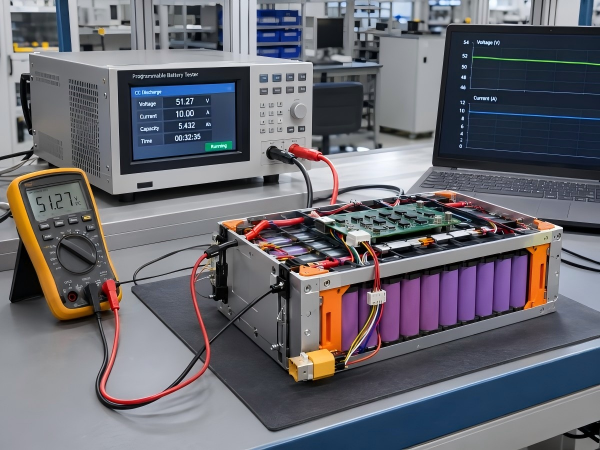
1. What Is Battery Pack Design Validation?
Battery pack design validation is the process of evaluating whether a battery pack meets its defined technical requirements under specified test conditions.
Validation activities may include engineering calculations, design reviews, prototype inspection, functional testing, and application-specific evaluation.
The process covers several areas:
Electrical performance
Charging and discharging behavior
BMS protection functions
Temperature monitoring
Heat generation and dissipation
Mechanical dimensions
Enclosure structure
Connector integration
Environmental conditions
Equipment compatibility
The validation scope depends on the battery application, electrical specifications, mechanical design, and applicable standards.
For custom battery packs, test procedures and acceptance criteria should be established according to the approved project requirements.
2. Electrical Testing for Lithium Battery Packs
Electrical testing evaluates battery operation under specified charging and discharging conditions.
It also verifies electrical connections, protection circuits, and communication interfaces.
Battery Voltage Verification
Voltage inspection confirms whether the battery pack and individual series-connected cell groups meet the specified voltage requirements.
Inspection items may include:
Total pack voltage
Individual cell group voltage
Voltage polarity
Voltage measurement accuracy
Cell group voltage differences
For example, a 16S LiFePO4 battery pack has a typical nominal voltage of 51.2V when using cells rated at 3.2V nominal voltage.
The actual voltage during charging and discharging depends on the battery's state of charge and cell specifications.
Battery Capacity Testing
Capacity testing evaluates the amount of electrical charge delivered by the battery under defined discharge conditions.
The test procedure generally specifies:
Charging method
Charging termination conditions
Discharge current
Discharge cutoff voltage
Ambient temperature
Rest periods where required
Battery capacity is commonly expressed in ampere-hours (Ah).
Battery energy is expressed in watt-hours (Wh) and can be determined by integrating voltage and current over the discharge period.
Test results should be evaluated against the approved specifications and testing conditions.
Continuous Discharge Testing
Continuous discharge testing evaluates battery operation at the specified continuous current.
Testing may include monitoring:
Battery voltage
Discharge current
Cell temperature
BMS temperature
Connector temperature
Protection status
For example, a custom industrial battery pack specified for 50A continuous discharge may be evaluated at the agreed current and ambient temperature.
The test duration and acceptance criteria should be defined in the project test plan.
Peak Discharge Current Testing
Some battery applications require short-duration current peaks during acceleration, lifting, or motor startup.
Applications include:
AGVs
AMRs
Service robots
Electric motorcycles
Industrial machinery
Peak current testing evaluates battery operation during specified current pulses.
The test procedure should define peak current, pulse duration, repetition conditions, and acceptance criteria.
Battery cells, BMS, busbars, wiring, and connectors should be evaluated according to the electrical requirements.
Charging Performance Testing
Charging verification evaluates battery operation according to the specified charging requirements.
Testing may include:
Charging voltage
Charging current
Charging termination behavior
Cell group voltage monitoring
Temperature monitoring
Charger compatibility
BMS charging protection
The charging procedure must follow the selected cell specifications and approved battery design.
3. BMS Functional Testing and Protection Verification
The Battery Management System monitors battery conditions and provides electrical protection functions according to its hardware and software configuration.
BMS validation is part of custom battery pack testing.
Overcharge Protection
Overcharge protection testing verifies that the BMS responds according to the defined cell voltage protection thresholds.
The test procedure should also evaluate the configured recovery conditions.
Over-Discharge Protection
Over-discharge protection testing evaluates the BMS response when cell voltage reaches the specified discharge protection threshold.
Validation includes checking the protection threshold and recovery conditions.
Overcurrent Protection
Overcurrent protection testing evaluates the BMS response to current conditions outside the defined operating limits.
The test scope depends on the battery's continuous current rating, peak current requirements, and protection settings.
Short-Circuit Protection
Short-circuit protection testing evaluates the response of the battery protection system under specified fault conditions.
Testing must follow an approved procedure using appropriate test equipment and safety measures.
Uncontrolled short-circuit testing must not be performed.
Cell Balancing Verification
Cell balancing manages voltage differences between series-connected cell groups according to the BMS design.
Depending on the BMS configuration, testing may include:
Balancing activation threshold
Balancing current
Balancing status
Cell voltage measurement
Balancing termination conditions
Temperature Protection
BMS temperature protection testing evaluates responses to defined temperature conditions.
Functions may include:
Charging over-temperature protection
Discharging over-temperature protection
Low-temperature charging protection
Temperature sensor fault detection
Temperature-based current limitation, where supported
The actual functions depend on the BMS hardware, firmware, and approved specifications.
4. CAN, UART and RS485 Communication Testing
Custom battery packs used in industrial equipment and robotics may require communication with external controllers.
Common communication interfaces include CAN, UART, and RS485.
Communication validation may cover:
Battery voltage reporting
Current reporting
State of Charge (SOC)
State of Health (SOH), where implemented
Temperature reporting
Fault information
Communication timing
Data format verification
Communication interruption handling
CAN Communication Testing
For AGV and AMR applications, the BMS may transmit battery information to the equipment controller through CAN communication.
The communication protocol should be defined before integration testing.
Required information may include CAN identifiers, bit rate, message structure, and data scaling.
CAN communication does not automatically provide control over battery charging or discharging. These functions depend on the BMS hardware, firmware, and agreed system design.
Equipment Integration Testing
Battery packs may require integration testing with the customer's equipment.
Testing may include:
Equipment startup
Communication compatibility
Charging operation
Discharge operation
Battery status monitoring
Fault information reporting
The test procedure should follow the approved communication protocol and equipment requirements.
5. Thermal Validation for Lithium Battery Packs
Thermal validation evaluates battery temperature behavior under specified operating conditions.
Lithium battery cells generate heat during charging and discharging due to electrochemical processes and internal resistance.
Electrical connections, busbars, wiring, connectors, and BMS power components also generate heat during operation.
Thermal testing evaluates battery temperature against the approved operating limits.
Temperature Rise Testing
Temperature rise testing measures temperature changes during defined charging or discharging conditions.
Monitoring locations may include:
Selected battery cells
Cell connection points
Busbars
BMS power components
Charging and discharging connectors
Battery enclosure surfaces
Thermocouples or suitable temperature sensors may be used according to the test plan.
High-Temperature Operation Testing
High-temperature testing evaluates battery operation under specified ambient temperature conditions.
Testing may cover:
Charging behavior
Discharge performance
Cell temperature
BMS temperature
Temperature protection functions
The test temperature and duration depend on the selected cell specifications and project requirements.
Low-Temperature Operation Testing
Low-temperature testing evaluates battery behavior in cold environments.
Evaluation items may include:
Discharge capacity
Voltage behavior
Discharge current capability
Low-temperature charging protection
BMS temperature monitoring
Charging and discharging temperature limits must follow the selected cell manufacturer's specifications.
Thermal Distribution Evaluation
Temperature distribution testing evaluates differences between monitoring points inside the battery pack.
The results can identify areas of heat accumulation near cells, electrical connections, or electronic components.
For battery packs installed inside enclosed equipment, thermal evaluation should consider the installation environment and surrounding heat sources.
6. Mechanical Testing for Custom Battery Packs
Mechanical validation evaluates the battery pack's physical structure and installation compatibility.
The test scope depends on the application and mechanical requirements.
Dimensional Inspection
Dimensional inspection verifies whether the battery pack meets the approved mechanical drawings.
Inspection items may include:
Length
Width
Height
Mounting hole positions
Connector locations
Cable outlet positions
Installation clearance
For custom robot batteries, dimensional compatibility should be evaluated according to the equipment's installation compartment.
Vibration Testing
Battery packs used in vehicles and industrial equipment may experience vibration during operation.
Vibration testing evaluates the battery pack under defined vibration conditions.
Inspection items may include:
Enclosure integrity
Cell fixing structure
Electrical connections
Connector retention
Mounting hardware
Electrical operation after testing
The vibration profile and test duration depend on the applicable requirements.
Mechanical Shock Testing
Mechanical shock testing evaluates the battery pack's response to specified mechanical impacts.
Test conditions should be established according to the battery application and relevant testing requirements.
Enclosure Integrity
Enclosure inspection evaluates mechanical assembly and structural condition.
Inspection items may include:
Housing assembly
Screw connections
Mounting brackets
Sealing components
Cable glands
Connector installation
Surface condition
Installation and Removal Testing
For removable battery packs, mechanical validation may include:
Battery insertion
Connector alignment
Locking mechanism operation
Battery removal
Mounting structure inspection
Cable accessibility
The evaluation should reflect the intended installation and maintenance procedures.
7. Environmental Protection Testing
Some custom lithium battery packs operate in environments involving dust, moisture, rain, or water spray.
Environmental testing may be required according to the equipment's installation conditions.
IP Rating Testing
Ingress Protection (IP) ratings are defined under IEC 60529.
Examples include:
| IP Rating | Protection Description |
|---|---|
| IP54 | Dust-protected and protected against splashing water |
| IP65 | Dust-tight and protected against water jets |
| IP67 | Dust-tight and protected against temporary immersion |
| IP68 | Dust-tight and protected against immersion under specified conditions |
The required IP rating depends on the application and environmental exposure.
The IP rating of an individual connector or enclosure component does not establish the rating of the complete battery pack.
Testing should consider the final assembled configuration, including housing joints, connectors, cable outlets, and sealing structures.
Humidity and Condensation
For applications involving humidity or temperature changes, the design may require evaluation of moisture exposure and condensation.
These conditions can affect electrical insulation, metal connections, and electronic components.
Test conditions should be determined according to the project requirements.
8. Applicable Standards and Certification Requirements
Battery pack validation may involve specific safety standards depending on the application and destination market.
Examples include:
| Standard | Application or Purpose |
|---|---|
| UN38.3 | Lithium battery transportation testing |
| IEC 62133-2 | Safety requirements for portable sealed secondary lithium cells and batteries |
| IEC 62619 | Safety requirements for industrial secondary lithium cells and batteries |
| EN 50604-1 | Safety requirements for lithium-ion battery systems in applicable light electric vehicle applications |
| UL 2271 | Safety requirements for batteries used in light electric vehicle applications |
| IEC 60529 | Degrees of protection provided by enclosures (IP Code) |
The applicable requirements depend on product classification, destination market, battery application, and certification scope.
Design Validation and Certification Testing
Engineering design validation and formal certification testing serve different purposes.
Design validation evaluates the battery against project-specific technical requirements.
Certification testing evaluates the product against applicable standards within the relevant assessment process.
Internal engineering test results do not constitute product certification.
Certification status should be supported by valid documentation covering the relevant battery configuration.
9. Battery Pack Prototype Validation Process
A custom battery pack validation process may include the following stages.
| Stage | Validation Activity |
|---|---|
| Technical Requirements | Confirm electrical, mechanical, thermal, and communication specifications |
| Design Review | Evaluate cell configuration, BMS, enclosure, and connectors |
| Prototype Assembly | Manufacture samples according to approved drawings |
| Electrical Testing | Verify voltage, capacity, charging, discharging, and protection functions |
| Thermal Testing | Evaluate temperature rise and operating conditions |
| Mechanical Testing | Verify dimensions, mounting, and applicable mechanical requirements |
| Equipment Integration | Evaluate battery operation in the customer's equipment |
| Design Approval | Document results and confirm required modifications |
| Production Preparation | Confirm specifications and manufacturing documentation |
The actual sequence depends on the project requirements.
If a design modification affects electrical performance, thermal behavior, or mechanical structure, the relevant validation activities should be reviewed.
10. Information Required for Battery Pack Validation
Before developing a custom lithium battery pack, OEM customers should provide the following information.
1. Battery Electrical Specifications
Nominal voltage, capacity, charging voltage, continuous discharge current, and peak discharge current.
2. Battery Chemistry
Ternary lithium-ion, LiFePO4, or another specified chemistry.
3. Mechanical Requirements
Battery dimensions, enclosure structure, mounting positions, and installation drawings.
4. Operating Conditions
Ambient temperature, operating duty cycle, vibration exposure, and environmental requirements.
5. BMS Requirements
Protection thresholds, temperature monitoring, balancing, and communication interfaces.
6. Connector Requirements
Charging, discharging, and communication connectors.
7. Testing Requirements
Required electrical, thermal, mechanical, and environmental test conditions.
8. Certification Requirements
Applicable standards and target markets.
9. Project Schedule
Prototype quantity, customer evaluation plan, and production requirements.
These details are used to establish the validation scope and technical acceptance criteria.
11. Custom Battery Pack Development at First Power
provides OEM and ODM custom lithium battery pack development and manufacturing services.
Our business covers electric mobility, robotics, industrial equipment, and energy storage applications.
Our customization scope includes:
Ternary lithium-ion and LiFePO4 battery pack configurations
Customized voltage and capacity
Battery cell selection
BMS customization according to project requirements
CAN, UART, and RS485 communication options
NTC temperature monitoring
Customized plastic and aluminum enclosures
Battery connector and wiring customization
Battery pack assembly
Technical documentation and project testing coordination
For custom battery pack projects, electrical specifications, thermal requirements, mechanical dimensions, and communication functions are considered during development.
The validation scope is determined according to the confirmed battery configuration, customer specifications, and applicable requirements.
Testing arrangements and required documentation are confirmed according to the project.
Conclusion
Battery pack design validation involves electrical testing, thermal evaluation, mechanical verification, and BMS functional testing.
Each validation activity addresses specific aspects of battery operation and design requirements.
For OEM and ODM projects, defining the validation scope during development helps establish acceptance criteria, testing procedures, and prototype approval requirements.
Whether the application involves an electric bicycle, AGV, AMR, service robot, or industrial battery system, validation should be based on the battery's electrical, mechanical, and environmental specifications.
Developing a custom lithium battery pack for your equipment?
Contact Dongguan Yizhan Electronics Technology Co., Ltd. (First Power) with your battery voltage, capacity, discharge current, mechanical drawings, BMS requirements, and testing specifications.
Our team can review your project requirements and discuss battery pack design, prototype development, and validation arrangements.

 E-mail



 +86 13510702894
