



Cycle Life vs. Calendar Life in Lithium Batteries
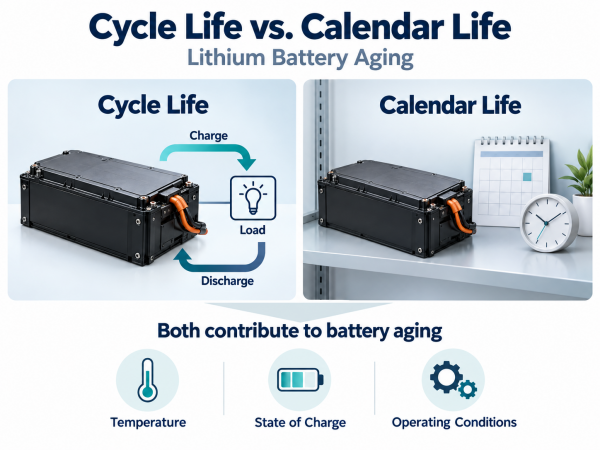
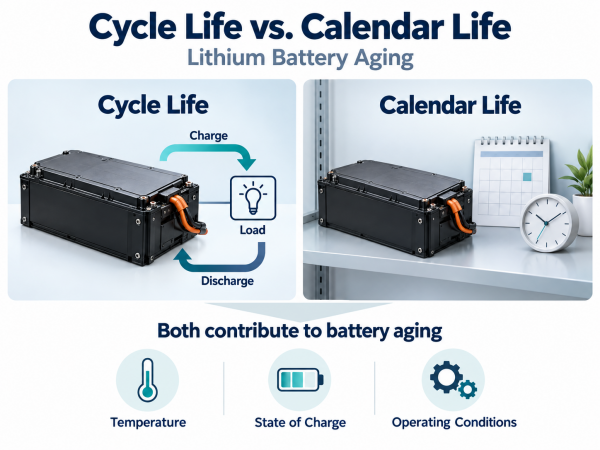
Lithium batteries age during operation and storage. Cycle aging relates to charge and discharge activity. Calendar aging relates to changes that occur over time.
Both contribute to battery service life. A cycle count alone does not establish how many years a battery will remain suitable for an application.
What Is Battery Cycle Life?
Cycle life is the number of defined charge–discharge cycles completed before a battery reaches a specified endpoint under stated test conditions.
The endpoint may be based on capacity retention, resistance or an application requirement.
A cycle-life statement should identify:
Cell or battery model.
Charging and discharge current.
Voltage limits.
Depth of discharge.
Temperature.
Rest periods.
Measurement procedure.
End-of-life criterion.
A statement such as “500 cycles” needs these conditions to explain what was tested.
What Counts as One Cycle?
The test procedure determines how cycles are counted.
During operation, partial discharges may be recorded as equivalent full cycles. For example, two discharges using 50% of a defined reference capacity may be counted as one equivalent full cycle.
This is a throughput calculation. It does not establish identical aging for different discharge patterns.
What Is Battery Calendar Life?
Calendar life is the elapsed time before a battery reaches a specified endpoint under defined storage or standby conditions.
Calendar aging can occur without regular charge–discharge operation.
A calendar-life assessment should document:
Storage temperature.
State of charge.
Storage duration.
Previous usage.
Measurement intervals.
End-of-life criterion.
Storage results do not establish performance during repeated cycling.
Cycle Life and Calendar Life
| Item | Cycle Life | Calendar Life |
|---|---|---|
| Reference | Charge–discharge cycles | Elapsed time |
| Expression | Cycles to a defined endpoint | Time to a defined endpoint |
| Test conditions | Current, voltage, depth of discharge and temperature | Temperature, state of charge and duration |
| Records | Cycling profile and throughput | Storage and standby history |
Both aging processes occur during service. Their effects should not be assumed to follow a fixed addition formula.
Why Cycle Count Does Not Establish Years of Service
Dividing a cycle count by daily usage produces an arithmetic estimate, not a validated service-life prediction.
For example, 500 cycles divided by one cycle per day equals 500 days. This calculation does not account for calendar aging or differences between laboratory and field conditions.
A service-life assessment also needs:
Actual duty cycle.
Temperature history.
Charging conditions.
Storage periods.
Operating state-of-charge range.
Replacement criteria.
A cycle count should not be presented as a guaranteed number of years.
What Does Capacity Retention Mean?
Capacity retention compares measured capacity with a stated reference capacity.
If the reference is 20Ah and the measured result is 16Ah under the defined procedure, capacity retention is 80%.
This percentage is a measurement result. It is not a universal replacement threshold.
An application should define its replacement endpoint. This may be the point when the battery cannot complete a task, supply the required power or meet a specified runtime.
Capacity Is One Part of Battery Assessment
Battery assessment may also include resistance and voltage behavior under load.
A battery may retain measurable capacity but reach the equipment’s voltage limit during a current demand.
Depending on the application, record:
Capacity.
Resistance using a defined method.
Voltage under load.
Operating temperature.
Task completion.
Use documented measurement conditions when reviewing results.
Conditions That Affect Battery Aging
Temperature
Record temperatures during storage, charging and discharge.
Ambient temperature does not establish cell temperature. Where required, measure the battery in its installed position.
Follow the selected cell and pack specifications for temperature limits.
State of Charge
Record the state-of-charge range during operation and storage.
Use the instructions for the selected battery model. One storage percentage should not be applied to every battery.
Depth of Discharge
State how much capacity is used during each test cycle.
Results from one discharge window should not be assumed to apply to another window.
Charging and Discharge Current
Record current levels, transient loads and their duration.
A constant-current test does not reproduce every equipment duty cycle.
Rest and Standby Periods
Include rest periods, standby operation and storage time.
These periods form part of the battery’s history even when no cycle is completed.
Cell Life Data and Battery Pack Life
A cell test does not establish the service life of an assembled battery pack.
The pack also contains:
Electrical connections.
Protection and monitoring electronics.
Cables and connectors.
Insulation.
Mechanical restraints.
An enclosure.
Pack operation depends on these components, cell variation, temperature distribution and protection settings.
Identify whether each life statement refers to a cell, module or complete pack.
How OEMs Can Specify Battery Life
Document the conditions associated with each life requirement.
| Requirement | Information to Define |
|---|---|
| Product | Cell model, pack configuration and revision |
| Operation | Load profile and daily schedule |
| Charging | Current, voltage, termination and temperature |
| Operating window | Voltage or state-of-charge limits |
| Storage | Temperature, duration and charge condition |
| Endpoint | Capacity, resistance or task requirement |
| Measurement | Procedure and reference conditions |
If an estimate uses an aging model, identify the input data, assumptions and validation limits.
Questions to Ask a Battery Supplier
Before using a life statement in a product specification, ask:
Does it refer to a cell or a complete pack?
What test conditions were used?
How was one cycle defined?
What endpoint was selected?
How many samples were tested?
Was the result measured or modeled?
Does the tested design match the supplied product?
Safety testing and life testing serve different purposes. A safety document does not establish cycle life unless the relevant performance assessment is included.
Storage and Maintenance Planning
Follow the model-specific instructions for storage temperature, charge condition and inspection intervals.
For batteries connected to equipment, account for standby consumption and define whether periodic charging is required.
Before returning a stored battery to operation, follow the specified inspection and charging procedure.
Do not continue using a battery showing damage, swelling or other abnormal conditions.
Frequently Asked Questions
Does a Battery Age When It Is Not Used?
Yes. Calendar aging can occur during storage. Its extent depends on the battery and storage conditions.
Does Every Charging Session Count as One Cycle?
No. Cycle counting depends on the defined method. A partial recharge is not automatically one full cycle.
Does a Battery Stop Working at Its Stated Cycle Count?
Not necessarily. The count refers to a test endpoint, not an automatic shutdown.
Is Calendar Life the Same as Warranty?
No. Calendar-life results describe performance under defined conditions. Warranty coverage follows the stated commercial terms.
What Should Determine Battery Replacement?
Use the application’s operating requirements, inspection results and defined replacement criteria.
Planning Battery Life for an OEM Project
Document cycle life and calendar life separately. Define the operating conditions, measurement methods and endpoints for each.
Use test evidence to support product statements. Present the conditions and limitations alongside the result, without converting a cycle count into an unsupported promise of service years.


 E-mail


 +86 13510702894